
Why do we feel calmer in nature ? The science behind this ancient prescription
Almost every ancient culture we researched in our study revealed that, its really important to be in nature and closer to nature.
Nowadays, its a prescribed medicine for mental wellness.
In many modern socieites today in Urban living, people prefer going for a walk in evening or morning then running in a gym.
Not only its healthy for the body, but it is healthy for the mind aswell.Within minutes — sometimes seconds — something shifts. The mental noise that felt permanent begins to quiet. Your shoulders drop. Your breathing deepens. The problem you were circling obsessively stops feeling urgent.
Our bodies are not accustomed to the environment we are living in currently, as soon as they reach their natural habitat for which they were designed for, we feel more calmer and relaxed.
The Mismatch Our Brain Lives With Every Day
For roughly 300,000 years, we as human beings lived in natural environments as hunters and gatherers. Our visual system always had natural surroundings, like trees , water, mountains around us. Whenever, birds used to squeak, we used to treat that as place for safety and any loud noises were always treated as a place for threat.
Trees always produce airborne chemical signals called as phytoncides. This is the reason why we are able to get a sense of smell around Eucalyptus or Pine trees. These phytoncides help the trees to grow, by warding off insects, reduce the growth of the competing plants and protect themselves.
Our ancestors, used to roam around these trees and forests and these walks used to help them improving their immunity.
Wondering why?
Our human immune system has a class of white blood cells called Natural Killer cells — NK cells — whose job is to identify and destroy virally infected cells and tumour cells. They are one of the body's primary defences against both infection and cancer.
When we walk through a forest and inhale phytoncides, our NK cell count and activity increase significantly. A study by Dr Qing Li at Nippon Medical School in Tokyo — the world's leading researcher on Shinrin-yoku — found that a single two-hour forest walk increased NK cell activity by over 50%. That enhanced NK activity persisted for more than 30 days after the walk.
In the last 200 years, which is around 0.07% of entire human evolution history, we have started living in cities, moving into straight lines, constantly focusing on screens in an air conditioned artificial light environment aways from the natural surroundings. Our brains still percieve the noise as threats.
Our human biological system has not completely eveolved with time and it’s still treating treating noise as threats, hungry for natural surroundings. The rise in anxiety, attention disorders, chronic stress, and mental fatigue is not a failure of willpower. It is a mismatch between biology and environment.
What happens when we step into the nature?
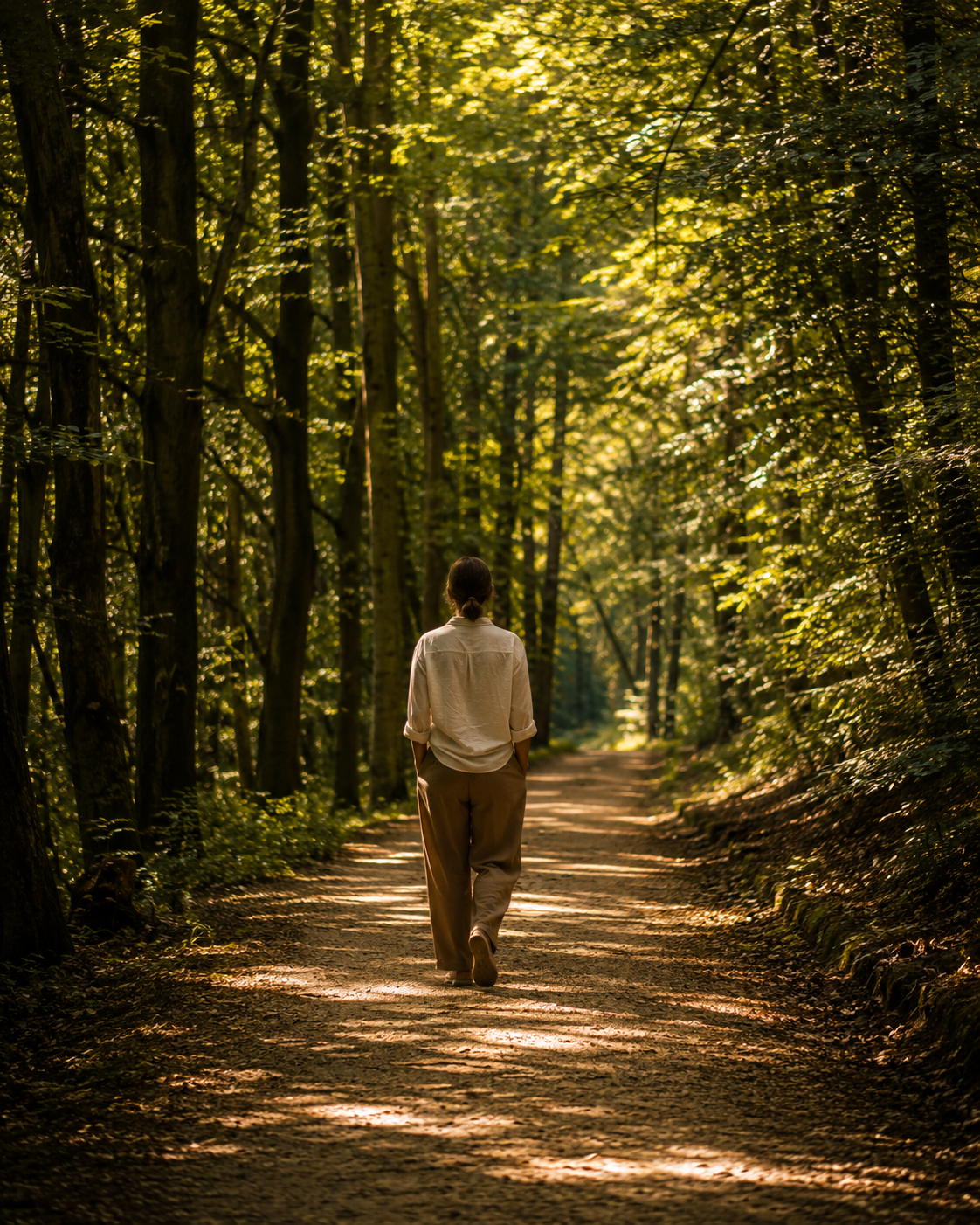
Psychologists Stephen and Rachel Kaplan discovered that human attention comes in two ways: One requires a lot of effort by deadlines and screens and other is with soft fascination — the effortless which is driven by clouds, leaves, and flowing water.
Directed attention depletes and does not recover on its own. Soft fascination refills it. One minute of nature during a fifteen-minute walk is enough to make you feel refresh and feel less stressed.
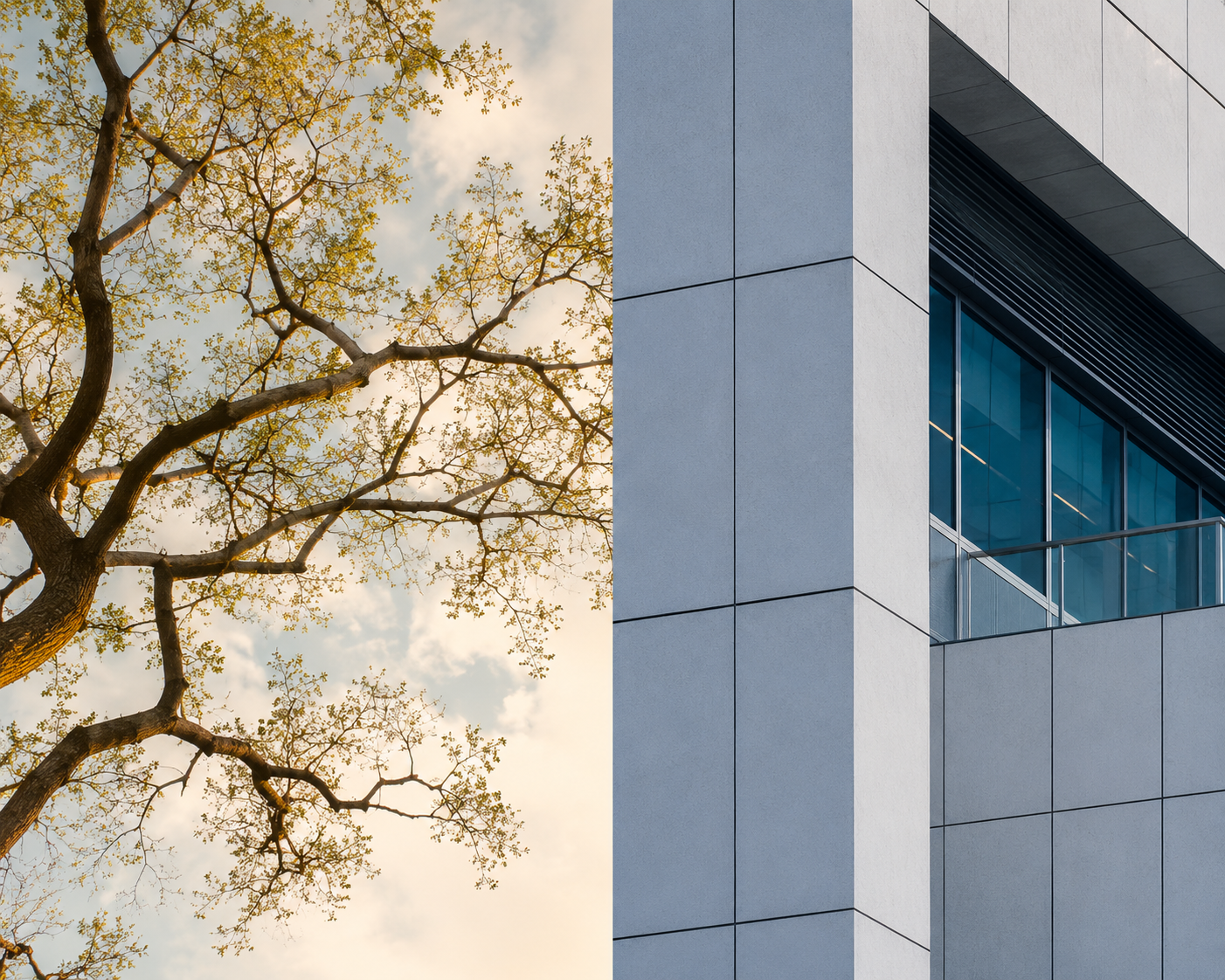
Did you ever notice nature has its own pattern. The branching of trees mirrors the roots or it. Edges of clouds feel like waves of an ocean. Mountain ranges to rocks have a same resemblance.
We are not designed to observe straight things.
Our urban envrionments are completely opposite to this, our buildings are straight, our roads are straight and even our dining tables.
Our visual system, is constantly struggling to adopt to these straight things and hence it comes up as a fatigue.
Ancient Cultures Knew All of This — Without the Neuroscience
India — Brahma Muhurata and Dincharya
Brahma Muhurata(Creator’s Hour) is the time 96minutes before sunrise. It is the best time for meditation, spiritual growth. This is the period when birdsong is at its most intense and diverse.
The Vedic concept of Prakriti — nature as the fundamental organising principle of existence — placed daily contact with the natural world at the centre of health. The Charaka Samhita's prescription of morning walks in natural surroundings within Dinacharya was not spiritual advice dressed as health guidance. It was health guidance that happened to be accurate.
Japan — Shinrin-yoku and the Concept of Ma
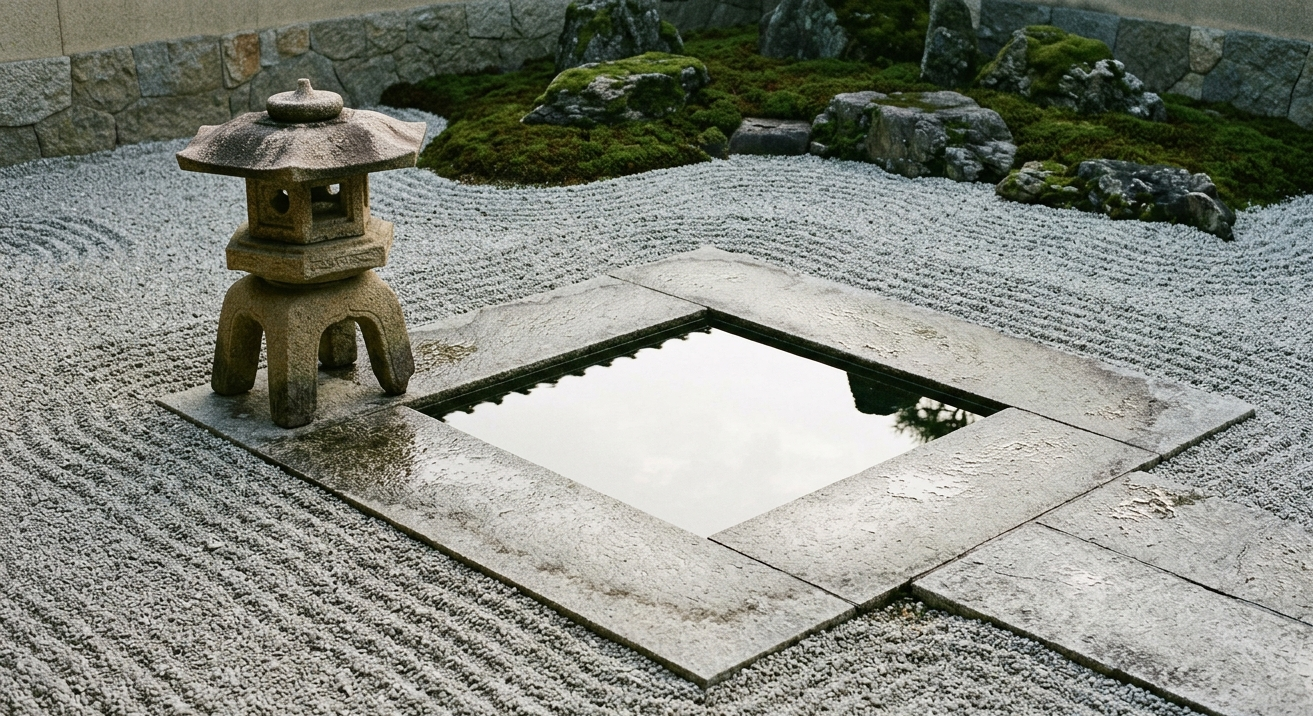
A Japanese Zen garden
Japan formalised what it had always practiced. Shinrin-yoku — forest bathing — was named as an official public health practice by the Japanese Ministry of Agriculture in 1982, but the practice itself is centuries older. Japan now has 62 officially designated forest bathing trails with clinical research stations measuring cortisol, blood pressure, and NK cell counts in visitors before and after immersion.
Equally significant is the Japanese concept of Ma (間) — the appreciation of space, silence, and the natural sound within that silence. Traditional Japanese garden design placed deliberate emphasis on water features, wind through bamboo, and bird habitats specifically for their auditory qualities. The sound of water over stone and the rustle of bamboo were considered as medically significant as the visual landscape. Japanese architects were prescribing soundscape therapy before the field existed.
China — Ziran and the Taoist Principle of Flow
Taoist philosophy offers the most elegant ancient parallel to Attention Restoration Theory through the concept of Ziran — naturalness or spontaneous alignment. Taoism suggests that when humans immerse themselves in nature, they adjust their internal state to match the environment, moving away from the effortful directed attention of human plans and toward the effortless state of Wuwei — non-forced action.
The Kaplan concept of soft fascination — allowing the mind to be acted upon by the environment rather than forcing the mind to act — is almost exactly what Wuwei describes. Two frameworks, developed independently, separated by 2,500 years and the entire breadth of Eurasia, describing the same cognitive mechanism.
Traditional Chinese Medicine placed mountain retreats at the centre of health restoration. The journey to altitude, the expanding visual field, the physical exertion, the silence, the natural soundscape — all of these are now understood to produce measurable parasympathetic activation, cortisol reduction, and attentional restoration. Chinese doctors were prescribing what we now call biophilic immersion.
Greece — The Peripatetics and Pythagorean Harmonics
Aristotle founded his school — the Lyceum — in a grove of trees sacred to Apollo. His students walked its garden paths while learning and thinking. They became known as Peripatetics — from peripatoi, the Greek word for the covered garden walks. Aristotle understood that movement through a natural space produced a quality of thought unavailable indoors or in the marketplace.
Pythagoras went deeper. He believed the natural world produced harmonic resonances that aligned with the human nervous system — what he called the Music of the Spheres. He used music derived from natural ratios to treat what he described as irrational disturbances of the mind. The Greek concept of Harmonia described the natural soundscape as an ordered cosmos — one that reduced anxiety and produced clarity precisely because its sounds were predictable, patterned, and safe.
Modern acoustic science confirms the mechanism he intuited: natural sounds are processed by the auditory cortex as ordered and predictable, reducing amygdala activation. Urban sounds are processed as disordered and unpredictable, maintaining the threat response. Pythagoras described this distinction through the lens of cosmic harmony. Neuroscience describes it through the lens of amygdala activation. Both are accurate.
Why pilgrimage was prescribed in all the religions?
Most of the pilgrimage sites are located high on mountains or in middle of natural beauty or around rivers and it used to be a practice in many families to go to the pilgrimage every year in the name of god. However, if you go deeper, this was prescribed in our religions so that families can bond together and can experience the nature.
Ex: The Bhutanese Tiger monastery is built at 3,000 metres on a sheer cliff face specifically because the journey and the view produce the cognitive reset that makes the mind ready for contemplation and the same with Kedarnath temple in India.
These locations were chosen for a reason and it was to bring the calmness to people visiting them.
What To Do With This Knowledge
The practical implications are simpler than the science:
Go outside before your first screen. The pre-dawn and early morning light, the residual birdsong of the dawn chorus, and the fractal complexity of outdoor environments are the most potent attentional restoration available to you — and they are free. Ancient India prescribed this as Dinacharya. Modern neuroscience confirms it as optimal cortisol rhythm anchoring.
Walk in green spaces, not just open spaces. A street of buildings does not produce fractal fluency. A street of mature trees does. A park bench near birdsong activates the amygdala's safety response. A park bench near traffic does not. The specific biological inputs matter.
Let yourself hear natural sounds. Open a window. Find running water. Play recorded birdsong if that is what is available. The auditory safety signal reaches the amygdala regardless of whether the source is physically present. This is not wellness advice. It is basic sensory nutrition.
Seek awe deliberately, at least occasionally. Not as a holiday. As a practice. A monthly visit to a place of genuine scale and beauty — a mountain, a coast, a large forest — produces NK cell enhancement lasting 30 days, DMN deactivation, and a reset of the rumination patterns that chronic stress builds up. Ancient cultures prescribed this through pilgrimage. Modern immunology validates it through NK assays.
Design your immediate environment for softness. Fractal patterns in textiles, organic shapes, plants, natural materials, views of trees or water — these are not decorative choices. They are cognitive environments. The visual system is processing your surroundings continuously whether you attend to it or not. An environment that contains natural geometry reduces the processing load on that system all day long.
An Honest Note
Nature is not a cure for clinical anxiety, depression, or serious mental health conditions. This article does not make that claim. If you are experiencing significant mental health challenges, professional support is the right first step.
What this article does say is that the human nervous system has a set of environmental requirements that are almost entirely absent from modern daily life — and that the consequence of that absence is visible in population-level mental health data across every industrialised country.
Ancient cultures did not have better mental health because they were spiritually superior. They had better access to the only environment their biology was designed for.
Sources
Kaplan S, Kaplan R. The Experience of Nature: A Psychological Perspective. Cambridge University Press. 1989.
Kaplan S. The restorative benefits of nature: Toward an integrative framework. Journal of Environmental Psychology. 1995. 🔗 https://doi.org/10.1016/0272-4944(95)90001-2
Taylor RP et al. Fractal fluency: An intimate relationship between the brain and processing of fractal stimuli. People and Places. 2021.
Li Q et al. Forest bathing enhances human natural killer activity and expression of anti-cancer proteins. International Journal of Immunopathology and Pharmacology. 2007. 🔗 https://pubmed.ncbi.nlm.nih.gov/17903349/
Piff PK et al. Awe, the small self, and prosocial behavior. Journal of Personality and Social Psychology. 2015. 🔗 https://pubmed.ncbi.nlm.nih.gov/25984788/
Gordon AM et al. Awe intervention for Long COVID — randomised controlled trial. 2023.
Ratcliffe E et al. Associations with bird sounds: memory, movement, and attention. Landscape and Urban Planning. 2023.
Gould van Praag CD et al. Mind-wandering and alterations to default mode network connectivity when listening to naturalistic versus artificial sounds. Scientific Reports. 2017. 🔗 https://www.nature.com/articles/srep45273
Jiang B et al. Physiological effects of viewing natural landscapes in actual versus virtual environments. Landscape and Urban Planning. 2019.
Charaka Samhita, Sutrasthana — on Dinacharya and morning practice. 🔗 https://www.carakasamhitaonline.com
