
Your Body Is Talking. Your Cravings Are the Translation.
Ayurveda didn't have labs. It had something rarer — three thousand years of watching what people craved, and interpreting them as what actually your body requires.
We often endup in a situation when our body suddenly craves for something. You reach for something sweet at 4pm. You pile extra salt on your food without thinking. You crave spice on a cold sluggish morning. You want something cooling when you are angry or overheated.
You have been told these are habits. Weaknesses. Lack of willpower.
Ayurveda says something different. It says your cravings are not noise — they are signal. Your body, is trying to tell you what it needs for smooth functioning.
Modern nutritional science has begun to confirm this. Not in every case, not perfectly, but enough to take seriously.
What Ayurveda Actually Says — And What It Doesn't
Before going further, its really important that we provide an honest clarification.
The specific claim that "sweet cravings = chromium deficiency" or "salty cravings = electrolyte imbalance" is not found in those precise terms in the Charaka Samhita or Ashtanga Hridayam. These ancient texts did not know about chromium or electrolytes as chemical compounds. Nobody did until the 20th century.
Ayurveda has always observed body to be closer to nature and it follows the same principles as that of nature.
Nature always advocates for balanace and equilibrium.
Ayurveda built a functional mapping. It observed that when the body craves a particular taste, something in the body's balance has shifted. It categorised those shifts by Dosha, by Agni, and by the six tastes (Shad Rasa). It prescribed foods in response.
The Ayurvedic framework and the modern science are describing the same phenomenon but with different perspectives.
The convergence of both of them to arrive at the same findings is the story of this article.
The Three Lenses Ayurveda Uses to Read Your Cravings
Lens 1: Dosha — Your Body's Default Setting
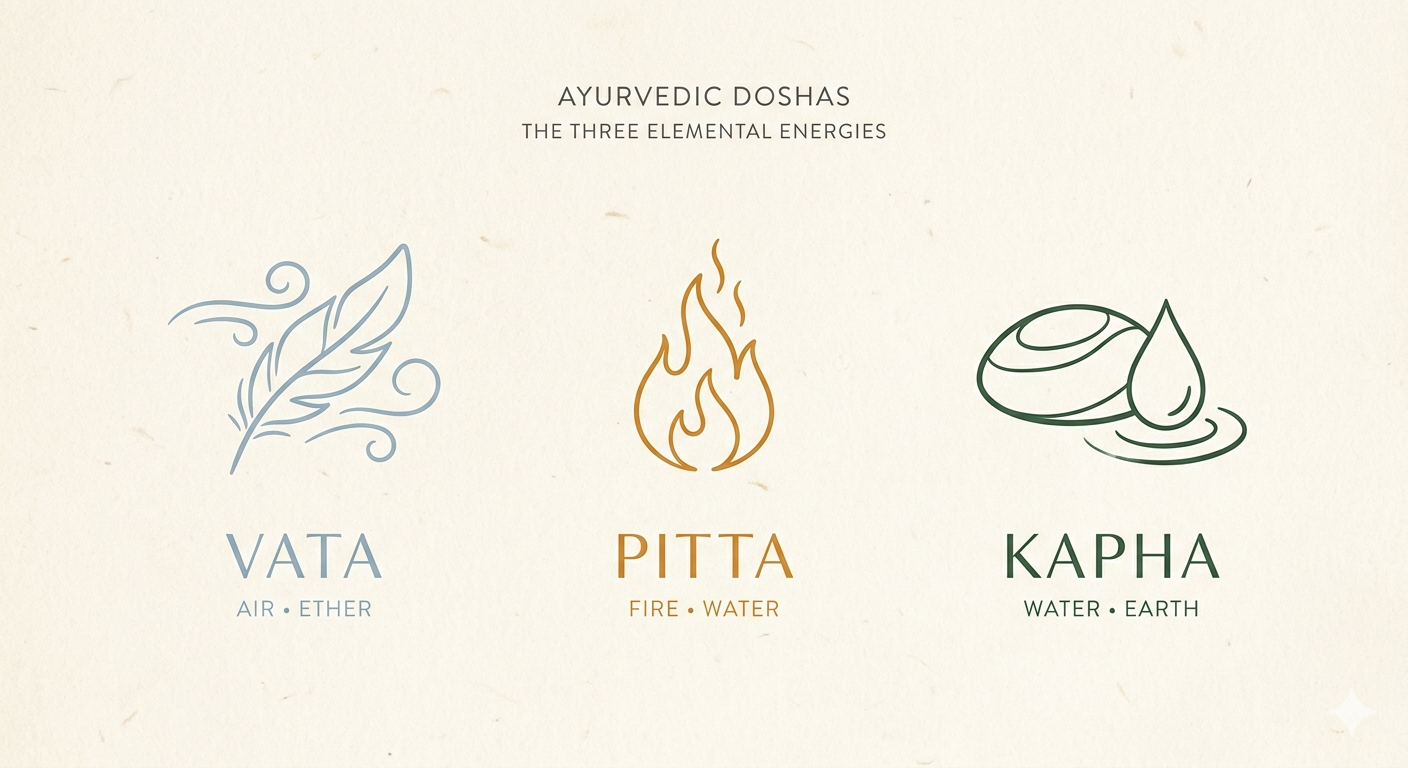
Ayurveda views health as a state of dynamic balance between body, mind, and environment. A central concept is that each person has a unique constitution composed of three fundamental energies, or Doshas: Vata, Pitta, and Kapha.
Think of your Dosha as your body's default setting — the baseline constitution you were born with. Every person contains all three in different proportions.
Vata — linked to air and space. Controls movement, the nervous system, circulation, and the flow of thoughts. When balanced: energetic, creative, mobile. When excess: anxious, restless, dry skin, irregular digestion, craving warm and oily foods.
Pitta — linked to fire. Controls metabolism, digestion, body temperature, and intensity. When balanced: sharp, confident, strong digestion. When excess: easily angered, overheated, inflamed skin, heartburn, craving cooling foods.
Kapha — linked to earth and water. Controls structure, moisture, stability, and calm. When balanced: strong, patient, grounded. When excess: heavy, sluggish, slow digestion, craving light and warming foods.
A simple example to make you understand this is let’s say you are feeling restless or anxious, which implies your Vata is imbalanced and in that stess you crave for oily food. This craving is driven from the fact that now to bring the body back to normalcy, it craves to eat dietary fat which results in you eating oily food.
Now, the learning is if you understand this principle, you will choose to eat a healthier alternative like ghee rather than some junk food.
Lens 2: Agni — The Digestive Fire

The Charaka Samhita states: 'When diet is wrong, medicine is of no use.'
Ayurveda views digestion as agni (which means fire). Its the force that breaks food down, extracts nutrients, converts matter to energy, and disposes of waste. In Ayurveda, most disease begins with impaired Agni.
Strong Agni — food digests quickly and completely. Hunger comes regularly. Energy follows meals. No bloating. You can eat almost anything.
Weak Agni — food sits heavy. Bloating is common. Fatigue after meals. Irregular bowel movements. The body craves light, easy-to-digest foods.
Irregular Agni — unpredictable. Strong one day, absent the next. The body gives contradictory signals — hungry, then not; energised, then exhausted.
Agni directly influences cravings. Weak Agni craves lightness. Strong Agni craves substance. Understanding your Agni tells you not just what to eat but how much and in what form.
Now the learning here is that to not to eat what a dietary chart or some random influencer tells you. Listen to your body, what it says and eat accordingly. Each body, each mind is different. Hence the same rule cannot be applied to all the cases.
If you want to move from a Weak Agni to a Strong Agni, you don't do it by just eating more "substance." You do it by Increasing the Demand:
Physical Movement: Exercise is the fastest way to "push" Agni. By moving your body, you create a biological demand for fuel. Your Agni "wakes up" to meet that demand.
Spices (The "Kindling"): Adding ginger, black pepper, or cumin to "light" food is like blowing air on a small flame. It makes the fire hotter without "smothering" it with a heavy log.
Intervals: Giving your body 4–5 hours between meals without snacking "pushes" the body to finish its work and get hungry again, which resets the system.
Lens 3: Shad Rasa — The Six Tastes
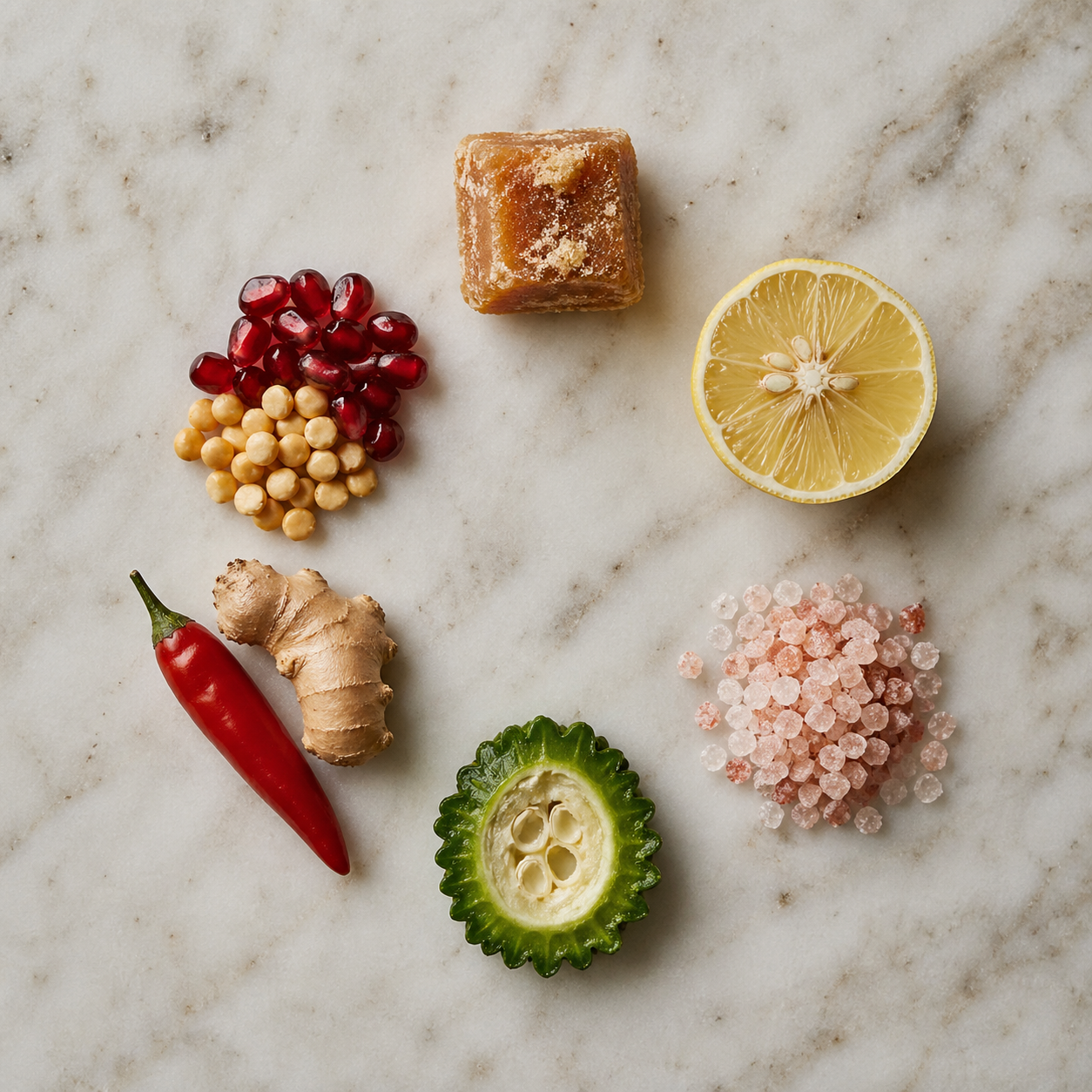
Ayurveda introduced the concept of Shad Rasa — the six tastes. Every food contains one or more of these tastes. Every taste performs a specific physiological function. And when your body is missing a function, it craves the taste that provides it.
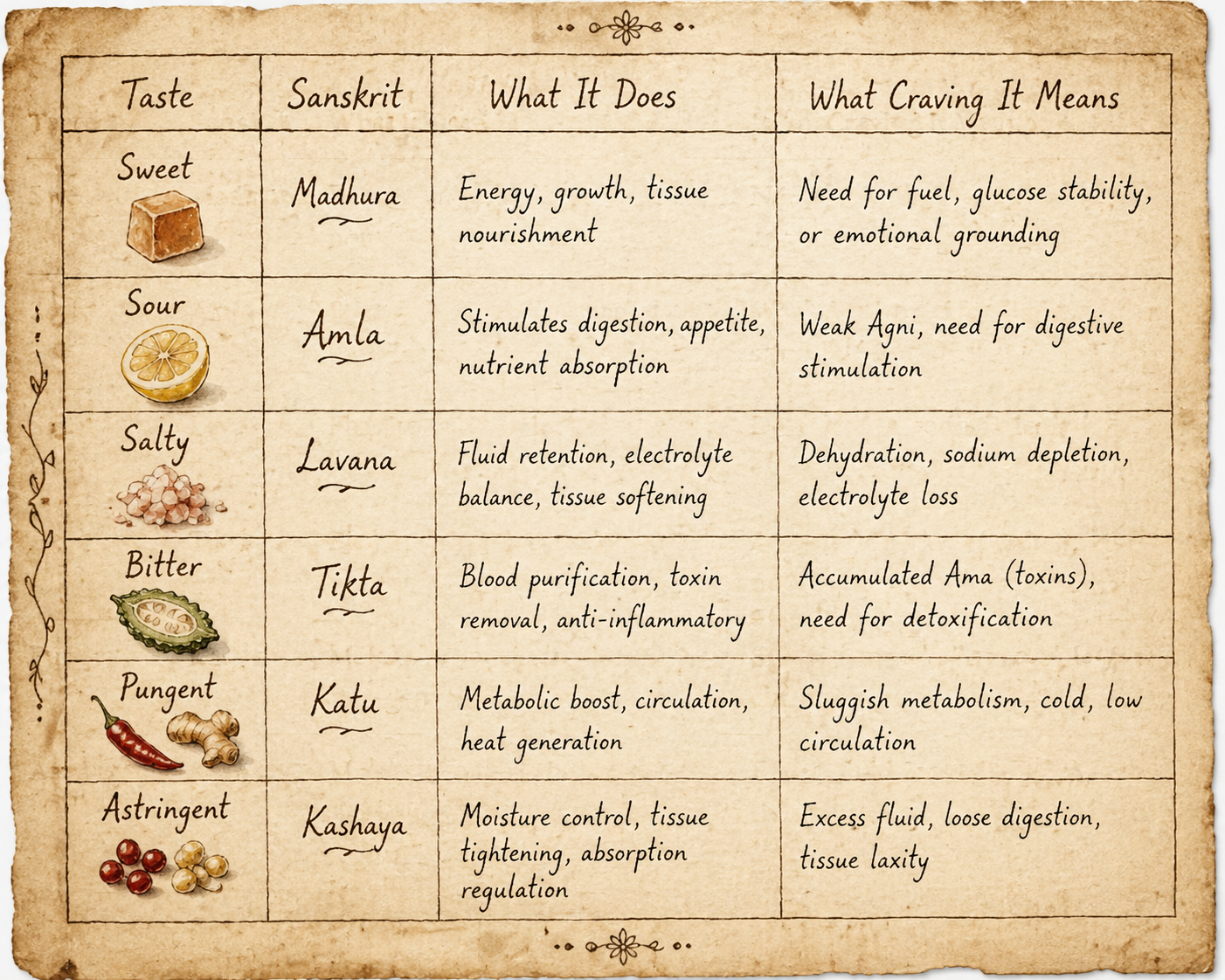
The key insight is this: your body craves what it is missing, not what it already has in excess. If you are craving for something it’s not your weakness but it’s what your body is telling you what it needs to maintain the balance.
Now, its upto you how do you want to handle this craving by eating something junk or meaningful.
Where Modern Science Meets Ancient Observation
Sweet Cravings
Ayurveda explains a sweet craving as the body seeking Madhura Rasa — energy, nourishment, grounding. It actually arises because of excess Vata (which depletes tissue) and weak Agni (which cannot extract energy from existing food).
Modern science describes this as: low levels of magnesium, chromium, and B vitamins can impair glucose metabolism and increase cravings for sweets. Magnesium supports over 300 enzymatic reactions, including those that regulate blood sugar. Chromium helps insulin transport glucose into cells for energy.
A peer-reviewed trial published in PubMed found that chromium picolinate supplementation produced measurable improvement in carbohydrate craving in adults. The mechanism — insulin signalling impairment — is precisely what Ayurveda described functionally as "the body seeking energy it cannot access from its existing food."
The Ayurvedic prescription for sweet craving is not sugar — it is warm milk, ghee, dates, cooked grains. These provide sustained glucose release and magnesium.
This is a classic example how did modern science and ancient science arrived at the same findings.
Salty Cravings
Ayurveda explains a salt craving as the body seeking Lavana Rasa to restore fluid balance and electrolyte stability — typically arising with Vata excess .
Modern science confirms: the most common cause of salt cravings is dehydration. When you're dehydrated, your body loses both water and electrolytes, including sodium. This creates an imbalance that your body tries to correct by making you crave salt.
Ayurveda's recommendation for Lavana foods — rock salt, sea salt, mineral-rich broths, salted water, buttermilk(chaach).
Spicy / Pungent Cravings
Ayurveda explains a craving for pungent food — chili, ginger, black pepper — as the body seeking metabolic heat. It specifically indicates low Pitta (sluggish digestion and metabolism) or excess Kapha (heaviness, slow circulation).
The Shad Rasa framework states that pungent taste increases metabolism, improves blood circulation, generates body heat, and improves digestion. This is thermogenesis — exactly what modern metabolism research documents when studying capsaicin, gingerol, and piperine, the active compounds in chili, ginger, and black pepper respectively.
A craving for spice on a cold, sluggish morning is the body asking for thermogenic stimulation. Ayurveda prescribed ginger tea. Modern sports nutrition prescribes pre-workout with capsaicin. Same signal. Same solution.
Bitter Cravings
A craving for bitter foods — dark chocolate, coffee, bitter gourd, leafy greens — is Ayurveda's most sophisticated mapping. It indicates accumulated Ama — undigested toxins — and the body seeking the Tikta taste that purifies blood, reduces inflammation, and clears the lymphatic system.
Modern hepatology documents that bitter compounds called iridoids (found in bitter gourd and many traditional bitter herbs) stimulate bile secretion, liver detoxification pathways, and gut microbiome diversity. When your body craves dark chocolate specifically, it may be asking for magnesium — chocolate contains measurable quantities. When it craves leafy greens, it may be asking for folate, fibre, and chlorophyll-based detoxification support.
An Honest Note on Limitations
Not every craving maps cleanly to a deficiency. Some cravings are habitual. It can be because of stress, boredom, or emotional states. Some are because of certain addictions aswell.
Ayurveda asks you to do self-observation. If you have persistent unexplained cravings accompanied by fatigue, dizziness, or other symptoms, consult a physician. A blood panel measuring magnesium, iron, B12, vitamin D, and glucose regulation will give you precise answers that no ancient framework can provide at that level of specificity.
What Ayurveda offers is a direction: pay attention to what your body is asking for, because it is usually asking for a reason.
Sources
Charaka Samhita, Sutrasthana — on Agni, Rasa, and food as medicine. 🔗 https://www.carakasamhitaonline.com
Ashtanga Hridayam, Sutrasthana 1.13 — Shad Rasa classification.
Chromium picolinate and carbohydrate craving trial. PubMed: 16184071. 🔗 https://pubmed.ncbi.nlm.nih.gov/16184071/
Salt cravings and dehydration — SiPhox Health. 🔗 https://siphoxhealth.com/articles/why-do-i-crave-salt-constantly
Traditional methods of food habits in Ayurveda — Journal of Ethnic Foods, Springer. 🔗 https://link.springer.com/article/10.1186/s42779-019-0016-4
Payyappallimana U, Venkatasubramanian P. Exploring Ayurvedic knowledge on food and health. Frontiers in Public Health. 2016. 🔗 https://www.frontiersin.org/articles/10.3389/fpubh.2016.00057
