
Why Do Indians Sit on the Floor to Eat? The Science Behind the Tradition
Your dining table holds your letters, your laptop, and whatever you bought last week. Your food goes on the floor. There is a reason for that.
There is a quiet ritual that plays out in millions of Indian homes every day. The food is ready. The family gathers. And instinctively — without discussion, without instruction — everyone sits on the floor.
No one decided this. No one enforced it. It simply is. And when someone asks why, the answer is usually a shrug: "It's our culture."
But culture is rarely random. Behind every ancient habit that survived thousands of years of change, there is usually a reason. Sometimes that reason is spiritual. Sometimes it is social. And sometimes — as modern science is now discovering — it is deeply, measurably physiological.
The practice of eating on the floor, in the cross-legged posture that Ayurveda calls Sukhasana, turns out to be one of the most quietly sophisticated health protocols that ancient cultures independently arrived at — from India to Japan to Korea to the Arab world. They didn't coordinate. They simply observed the human body long enough to understand it.
Every Ancient Culture Did This
Before we examine why floor eating works, it is worth understanding how universal it was.
In South Korea, the entire architecture of the home was built around the floor. The traditional ondol system — an underfloor heating network powered first by wood smoke, then by heated water — made the floor the warmest surface in the house. Domestic life naturally gravitated downward. Dining, sleeping, socialising, working — all happened at ground level. The traditional dining posture, called Yangban style, involves sitting cross-legged to maximise contact with the heated surface while keeping the spine upright.
In Japan, floor sitting was codified into a formal posture called seiza — a disciplined kneeling position that developed among the samurai class during the Edo period as an expression of respect, readiness, and alertness. Meals were eaten on tatami mats at low tables. In Okinawa — one of the world's Blue Zones, where people routinely live past 100 — centenarians sit on the floor to eat, read, and socialise every single day, rising and descending dozens of times without assistance.What you do in the morning sets the tone for every meal that follows. Here’s how Japanese structured their mornings.
In the Arab world, eating on the floor is embedded in the Sunnah — the traditions of the Prophet Muhammad — as an act of humility. The posture involves one knee raised against the chest, creating what turns out to be a natural mechanical restriction on how much food the stomach can hold. Islamic dietary guidance prescribes filling only one-third of the stomach with food — a principle that the posture itself physically enforces.
In India, the Ayurvedic texts prescribed Sukhasana — the easy cross-legged pose — as the correct posture for eating. The reasoning was precise: the posture calms the nervous system, channels vital energy through the body's nadis, and prepares the digestive tract for the efficient assimilation of nutrients. Food placed on the floor or a banana leaf requires a gentle forward hinge to retrieve each morsel — a rhythmic motion that was understood to physically massage the abdominal organs.
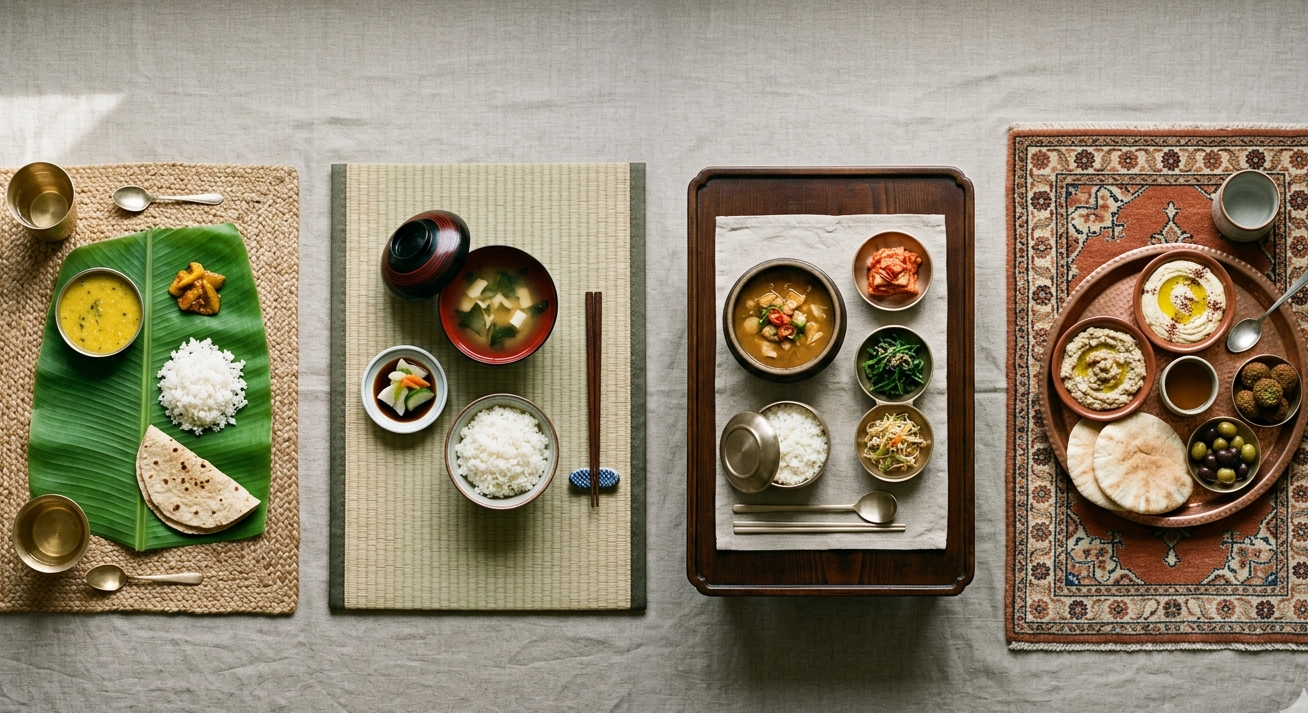
An Indian Plate on Banana Leaf, Japanese lacquered bowl on tatami, Korean low table setting, and Middle Eastern communal platter
What Sukhasana Actually Does to Your Body
Modern science has now examined what happens physiologically when you sit cross-legged on the floor to eat. The findings are striking.
Your core never stops working. Biomechanical studies using electromyography — which measures electrical activity in muscles — show that floor sitting activates up to 40% more stabilising muscles than chair sitting. Without a backrest to lean on, your deep core muscles, spinal erectors, and intrinsic back muscles fire continuously to keep you upright. This is not effort you feel. It is quiet, constant, low-grade muscular engagement — the kind that prevents the postural muscle atrophy that afflicts sedentary modern populations.
Your blood goes where digestion needs it. When you fold your legs into Sukhasana, you reduce the cardiovascular demand of pumping blood to your lower limbs. The body redirects this circulatory resource toward the splanchnic region — the network of blood vessels supplying the stomach, intestines, liver, and spleen.When digestion works well, cravings become signals rather than noise.Ayurveda gives insights what your cravings tell about you. Better blood supply to the gut means better synthesis of digestive enzymes, better secretion of gastric acid, and more efficient peristalsis. Ancient India had an equally precise understanding of when to eat — not just how.Read how Ayurveda's concept of Vishamashana explains why meal timing matters as much as posture.
Your vagus nerve is stimulated. Sitting upright on the floor naturally shifts breathing from shallow, chest-level breaths to deeper, diaphragmatic breaths. The diaphragm's expansion mechanically stimulates the vagus nerve — the primary neural pathway between the gut and the brain. Enhanced vagal tone triggers the parasympathetic state: heart rate slows, blood pressure normalises, and the body shifts from "fight or flight" into "rest and digest." The same process that ancient India activated at mealtimes was also the foundation of its sleep practices. Here is what Ayurveda prescribed about sleep practices.
Your food moves faster through your stomach. Clinical studies using gastric imaging have consistently shown that an upright sitting posture significantly accelerates gastric emptying compared to a slumped or reclined position. In one measurement, the flow of food through the pyloric sphincter — the gateway between stomach and small intestine — was 586 cm/sec in an upright sitting position, compared to just 177 cm/sec when lying down. The upright posture uses gravity intelligently. Food descends into the distal stomach efficiently, moves through, and begins intestinal absorption faster.
You absorb protein more effectively. A peer-reviewed study published in PubMed investigated how posture affects amino acid absorption after eating protein. The results showed that upright sitting produced significantly higher peak plasma leucine concentrations than a reclined position — 213 μmol/L versus 193 μmol/L. Leucine is the critical amino acid that triggers muscle protein synthesis. The posture you eat in determines how efficiently your body builds and repairs itself from the food you consume.
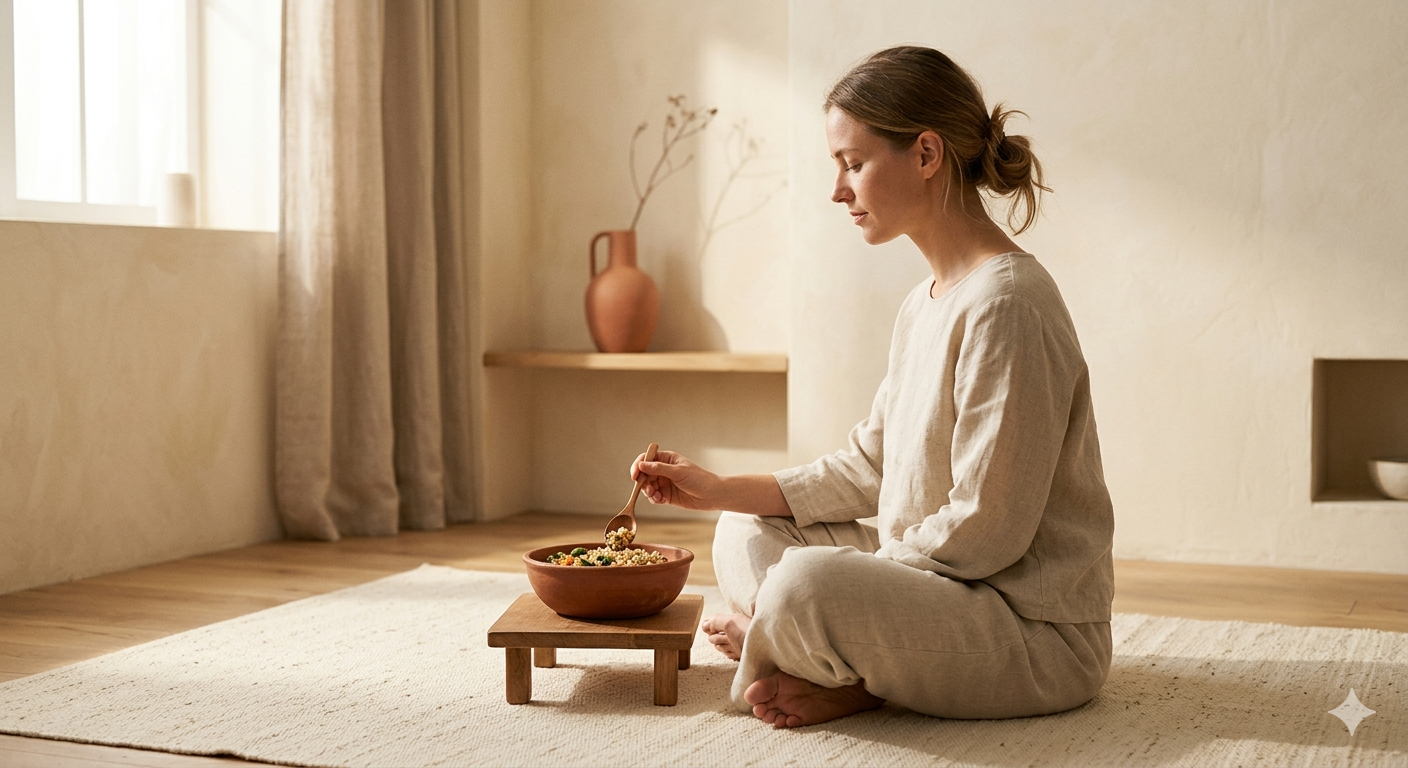
The Rhythm of Leaning Forward
There is one detail of floor eating that Ayurvedic texts described precisely and that modern physiology now corroborates.
When food is placed at ground level, retrieving each morsel requires a gentle forward hinge at the hips — and then a return to upright to chew and swallow. This rhythmic oscillation repeats with every bite.
This motion, observed closely, is a subtle mechanical massage of the abdominal region. The forward hinge compresses the digestive organs lightly. The return to upright releases them. Repeated dozens of times across a meal, this movement stimulates the secretion of digestive juices, promotes peristaltic movement, and keeps the gut mechanically engaged throughout eating — rather than passively receiving food in a motionless slumped posture.
The ancients described this as massaging the agni — the digestive fire. The physiology describes it as mechanical stimulation of the enteric nervous system. They are describing the same thing.
The Sitting-Rising Test and Longevity
Perhaps the most striking modern evidence for floor eating culture comes from an unexpected place — a mortality study.
Brazilian physician Dr. Claudio Gil Araújo developed what he called the Sitting-Rising Test: simply sit down on the floor without using your hands, knees, or forearms for support, then stand back up the same way. The test is scored out of 10. In a landmark longitudinal study of 2,002 adults aged 51 to 80, those who scored in the lowest category — 0 to 3 out of 10 — showed a mortality risk five to six times higher over the follow-up period than those who scored 8 to 10.
The ability to get up from the floor without assistance requires the simultaneous integration of core strength, lower body power, joint mobility, and neuromuscular coordination. It is a snapshot of the body's functional age.
In Okinawa's floor-living culture, this test is not taken annually in a clinic. It is taken three times a day, every time a person sits down to eat and stands back up. The daily ritual of floor eating is, incidentally, one of the most potent anti-ageing physical practices a body can perform — requiring no gym, no equipment, and no schedule.
What We Lost When the Chair Arrived
The dining table — as a daily eating surface — is a relatively recent invention. In much of the world, it arrived with industrialisation, the rise of the middle class, and the aspiration to Western domestic aesthetics.
In India, the shift has been particularly visible within a single generation. Grandparents who ate on the floor their entire lives now sit at dining tables that, as you noted, mostly hold laptops and unread letters. The floor posture was not replaced by something better. It was replaced by something aspirational — a symbol of modernity that happened to be physiologically inferior.
The chair, for all its comfort, does something that floor sitting does not: it turns off your core. With a backrest supporting the spine and the legs hanging passively, the stabilising muscles go dormant. Chair sitting for extended periods has been shown to blunt the suppression of ghrelin — the hunger hormone — after a meal, leading to sustained hunger signals and compensatory overeating even when the body has received sufficient calories.
Breaking up chair sitting with brief postural transitions — like sitting on the floor and standing back up — has been clinically shown to lower postprandial insulin concentrations by roughly 11% and increase energy expenditure by 16.6% compared to uninterrupted sitting. The ancient three-times-daily sit-to-floor-and-back was doing this automatically.
The Floor as Social Architecture
There is something that happens when everyone sits on the floor together that cannot be replicated at a dining table.
At a rectangular dining table, hierarchy is encoded into the furniture. There is a head of the table. There are seats of seniority. The physical arrangement announces who matters most before a single word is spoken.
On the floor, arranged in a circle around a shared meal, there is no head. Everyone is at the same height. Everyone reaches the same distance to the food. Sociological research confirms what traditional cultures have always understood: eating on the floor democratises the social space in a way that elevated dining cannot.
Oxford evolutionary psychologist Robin Dunbar's research on social eating found that individuals who eat communally have wider support networks, experience greater community engagement, and report significantly higher levels of happiness and trust. The physical intimacy of floor dining — the closeness of bodies, the shared platter, the absence of individual compartmentalised place settings — amplifies these effects. The floor is not just a posture. It is a social architecture.
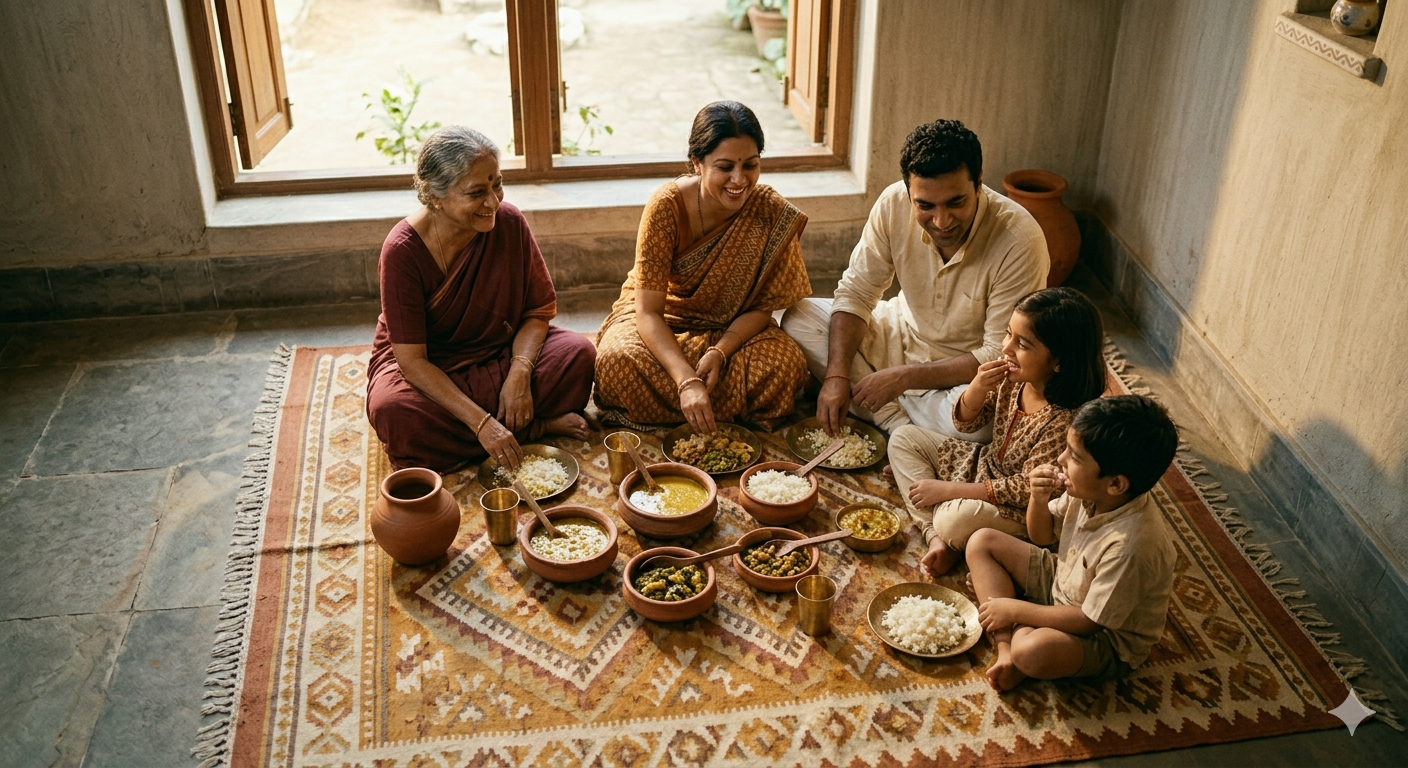
The Shoe-Free Consequence
Every culture that eats on the floor has one thing in common beyond the posture: shoes come off at the door.
In Japan and Korea, homes are architecturally designed with a sunken entryway — the genkan — specifically demarcated for removing outdoor footwear before stepping into the living space. In Indian homes, this is equally instinctive. Shoes stop at the threshold.
This custom, which most people understand as courtesy or tradition, turns out to be serious epidemiological hygiene. Microbiological studies of shoe soles consistently reveal active colonisations of E. coli and Clostridioides difficile — a bacterium responsible for severe, antibiotic-resistant gastrointestinal infection. Environmental health research has documented that shoes track in pesticide residues, heavy metals, asphalt carcinogens, and microplastics from outdoor surfaces.
Because the floor serves simultaneously as a dining surface, a meditation space, and the primary play area for young children, keeping it clean is not optional. Floor dining, in this way, enforces a domestic hygiene standard that protects the household from a wide range of pathogen exposures — automatically, as a consequence of the practice itself.
The ancient Indian instinct to remove footwear before entering the home was not superstition. It was applied epidemiology.
An Honest Note
This is not a prescription. Floor sitting requires hip flexibility and joint mobility that some people — particularly those with knee conditions, arthritis, or limited range of motion — may not have comfortably. The research also shows that long-term extreme knee flexion postures carry some risk of knee joint stress, particularly in older populations.
Traditional cultures understood this too. Japanese zabuton floor cushions and zafu meditation seats were developed precisely to raise the hips above the knees, restoring spinal alignment while reducing knee pressure. The wisdom was not rigid. It adapted.
What this article does say is that the instinct to sit on the floor — to eat low, to move down and up daily, to share food in a circle — was not primitive. It was precise. And the science is catching up.
Sources
Araújo CGS et al. Ability to sit and rise from the floor as a predictor of all-cause mortality. European Journal of Preventive Cardiology. 2012. PubMed: 23242910. 🔗 https://pubmed.ncbi.nlm.nih.gov/23242910/
van Loon LJC et al. Food ingestion in upright sitting position increases postprandial amino acid availability compared to lying down. PubMed: 28212491. 🔗 https://pubmed.ncbi.nlm.nih.gov/28212491/
Biomechanical Effects of Different Sitting Postures on the Lumbar Spine: A Finite Element Study. PMC. 🔗 https://pmc.ncbi.nlm.nih.gov/articles/PMC10525568/
Postural and spinal stability analysis for different floor sitting styles. PMC. 🔗 https://pmc.ncbi.nlm.nih.gov/articles/PMC11408770/
Effects of posture on gastric emptying, transpyloric flow, and hunger. PubMed: 16838120. 🔗 https://pubmed.ncbi.nlm.nih.gov/16838120/
Appetite regulation in response to sitting and energy imbalance. PubMed: 22462636. 🔗 https://pubmed.ncbi.nlm.nih.gov/22462636/
Breaking up sedentary time with chair squats on postprandial metabolism. PubMed: 30058957. 🔗 https://pubmed.ncbi.nlm.nih.gov/30058957/
Do slumped and upright postures affect stress responses? PubMed: 25222091. 🔗 https://pubmed.ncbi.nlm.nih.gov/25222091/
Shoe soles as a potential vector for pathogen transmission. PubMed: 27495010. 🔗 https://pubmed.ncbi.nlm.nih.gov/27495010/
Habitual floor activities increase risk of knee osteoarthritis. PubMed: 16980903. 🔗 https://pubmed.ncbi.nlm.nih.gov/16980903/
Dunbar R. Social eating connects communities. University of Oxford. 2017. 🔗 https://www.ox.ac.uk/news/2017-03-16-social-eating-connects-communities
Blue Zones. Why the Okinawan practice of sitting on the floor is linked to longevity. 🔗 https://www.bluezones.com/2020/07/why-the-okinawan-practice-of-sitting-on-the-floor-is-linked-to-health-mobility-and-longevity-how-you-can-practice-it-at-home/
Charaka Samhita, Sutrasthana — on Agni and digestion. 🔗 https://www.carakasamhitaonline.com/index.php/Agni
FAQs
Q.Why do Indians sit on the floor to eat? Sitting cross-legged in Sukhasana activates the parasympathetic nervous system, redirects blood flow to the digestive organs, stimulates the vagus nerve, and engages 40% more core muscle than chair sitting. Ayurveda prescribed this posture specifically as part of Dinacharya — the daily health routine — for its precise digestive benefits.
Q. What is the name of the floor-sitting posture used for eating in India? The posture is called Sukhasana — the easy cross-legged pose — one of the foundational postures of Hatha Yoga. Ayurvedic texts describe it as the correct seated position for eating because it grounds the body, calms the nervous system, and optimises digestive blood flow.
Q. What cultures sit on the floor to eat? India, Japan, South Korea, and Arab cultures all independently developed floor-based eating traditions. In Okinawa — one of the world's Blue Zones — centenarians eat on the floor daily. In Japan it is called seiza. In Korea, the ondol heated floor system made floor dining the natural choice. In Islamic tradition, eating on the floor follows the Sunnah as an act of humility.
Q. Is eating on the floor actually healthier than a chair? Peer-reviewed research confirms that upright floor sitting accelerates gastric emptying, improves amino acid absorption, activates core musculature, and stimulates the vagus nerve. A longitudinal study of 2,002 adults found that the ability to sit on the floor and stand without support predicts all-cause mortality — people who cannot do it have a five to six times higher mortality risk.
