
Gross National Happiness: How Bhutan Measures Success Differently and why it matters?
What Is Gross National Happiness?
While most of the world views success of a nation with GDP growth. Bhutan on the other hand views its success based on the happiness of it citizens.GNH recognizes that true progress depends on balancing material prosperity with psychological wellbeing, environmental sustainability, cultural preservation, and good governance. In my visit to Bhutan, I found that people really want to live closer to nature and preserve and grow in community for well being.
One can visit Clock Tower square in Thimphu which is a central market. There is an inherent silence in the area but you can see families walking by, kids playing. There is a sense of less hustle and more mindfulness.
What makes Bhutan so different?
People speak slowly, without urgency. Conversations are unhurried. There is no ambient noise of anxiety — no horns, no competing music, no urgency transmitted through voice. The Bhutanese don't project. They don't perform. They speak as though they assume they will be listened to.
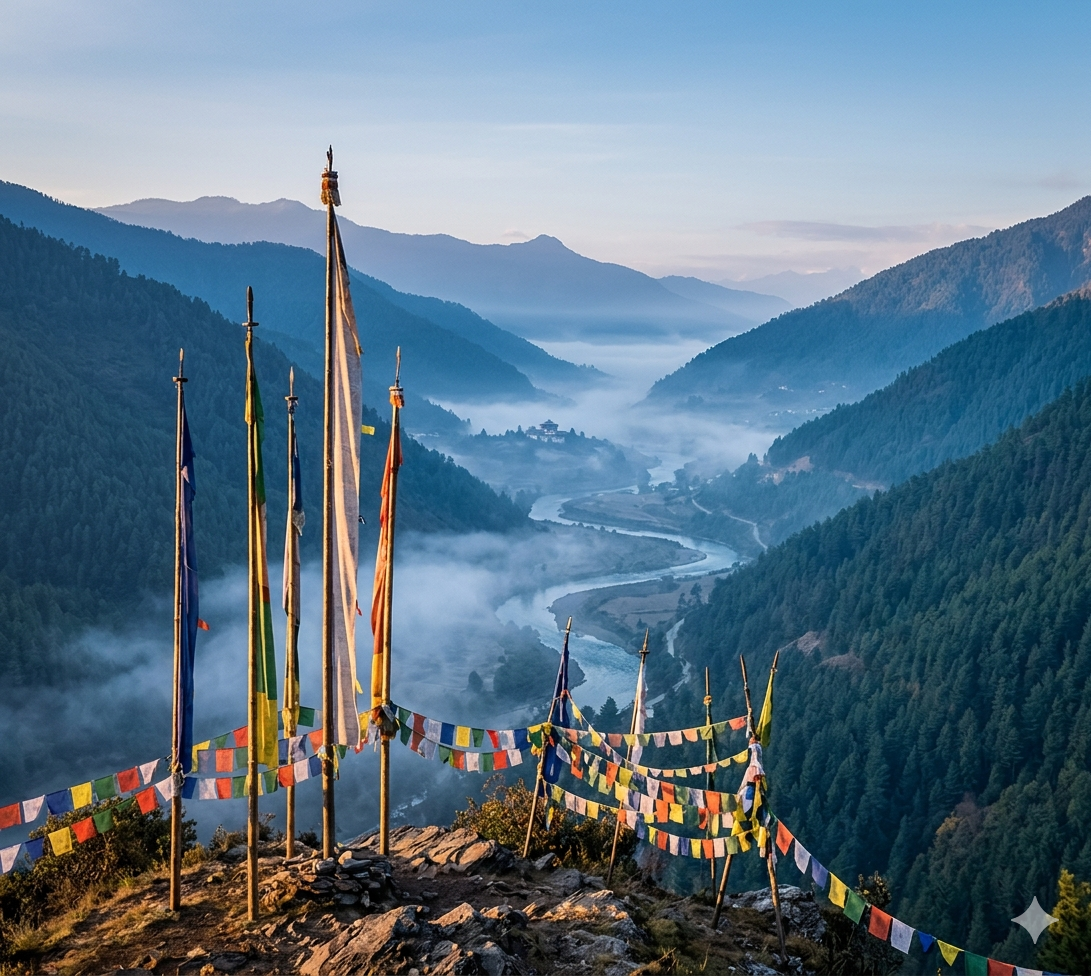
The air — literally — is different. Seventy percent of the country is covered in forest, and the constitution mandates it must stay that way. The buildings follow the landscape rather than replacing it. The national dress worn by nearly every adult in every formal setting is the same regardless of income or status. There is a quality of settled-ness — a sense that the culture knows what it is and is not in a hurry to become something else.
You leave with the uncomfortable feeling that something you cannot name is present there, and absent almost everywhere else.
Practice of Minimalism
In most of the world, minimalism is a design choice — a magazine style, a decluttering trend, a reaction to consumer excess. In Bhutan, it is an ancestral practice rooted in the Buddhist concept of the Middle Way.
The Middle Way advocates a path which lies between the extremes of self-indulgence and ascetism. Through this they try to live a balanced life.
This philosophy is visible in every layer of Bhutanese life
Architecture: Traditional homes use locally sourced natural materials like rammed earth, stone, and timber. Interiors prioritize open space that breathes over furniture that impresses. Decoration is intentional—featuring intricate carvings of the eight auspicious symbols—but clutter does not exist because clutter was never aspired to.
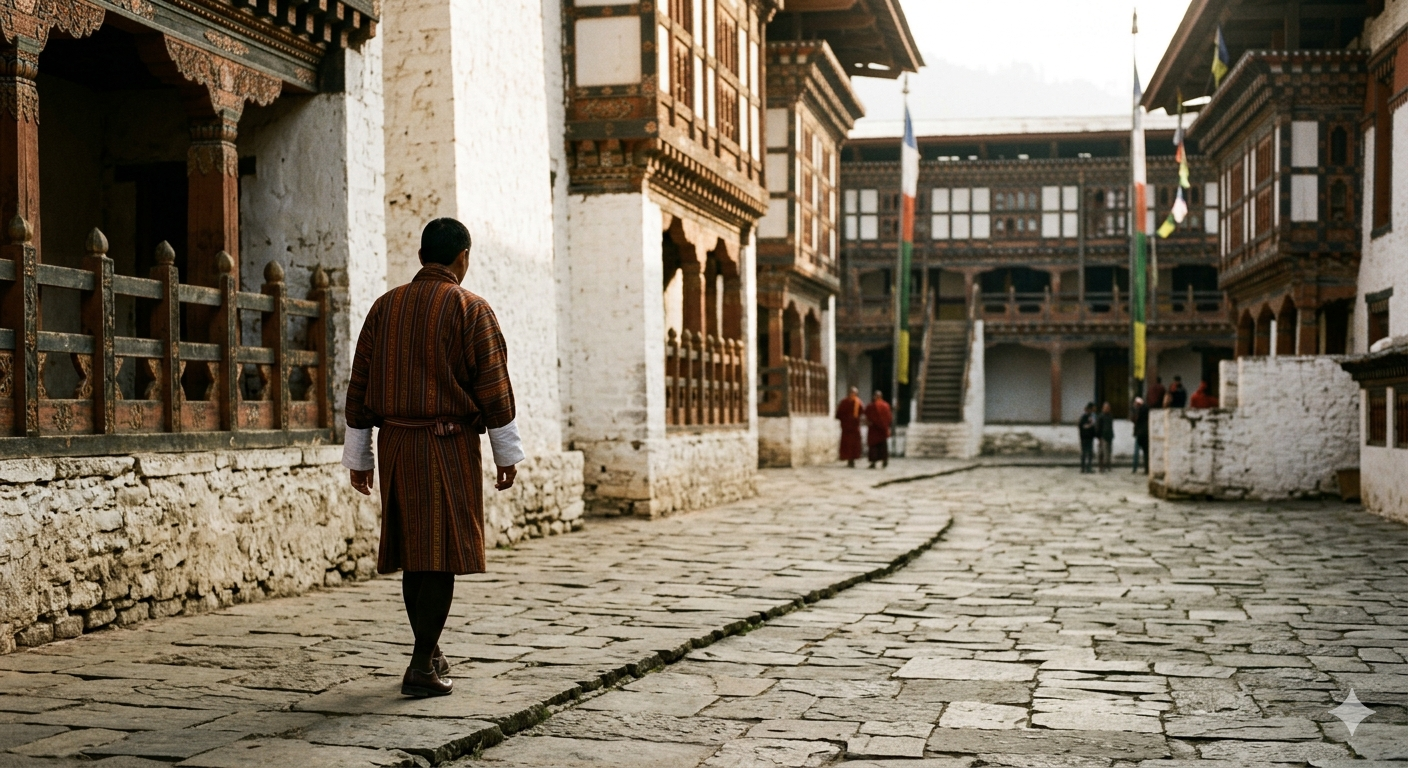
National Dress: The Bhutanese costume is perhaps the world's most elegant example of functional minimalism.
The Gho—a knee-length robe worn by men—features a large frontal pouch called the hemchu used to carry items like a wallet and mobile phone, eliminating the need for a bag.
Women wear the Kira, an ankle-length wrap dress mandated in formal settings, schools, and government offices.
By wearing the same kind of garment regardless of wealth, the state erases fashion as a status display.
Art of speaking calmly
As a visitor you will notice that there is a certain slowness, softness and absence of urgency in thier culture.
In 1989, the Bhutanese government issued a royal decree making Driglam Namzha mandatory for all citizens. It moved from being a cultural tradition to a strict national law under a policy known as "One Nation, One People".
This formal code breaks human interaction into three layers, recognizing that your body, your words, and your mind are completely linked.
Physical Behavior (The Sociological Layer): The code dictates how you walk (slowly, especially in sacred spaces), how you eat (silently, waiting for elders), and how you dress. Sociologically, this creates an environment of profound equality. If everyone is moving deliberately and wearing the exact same garment, the visual cues of class, wealth, and status anxiety are erased.
Verbal Communication (The Biological Layer): The code strictly forbids loud talking, shouting, or harsh tones, and requires specific respectful words (honorifics). When people are forced to speak softly and carefully, it prevents the spikes in cortisol (stress hormones) that usually come from aggressive, loud environments.
Inner Orientation (The Psychological Layer): You cannot follow the physical and verbal rules on autopilot. To adhere to this code of conduct one needs to be in a state of mindfulness and this is what helps in mental well being.
Modern neuroscience offers a framework for what this produces. Chronic noise and verbal aggression elevate cortisol and dysregulate the prefrontal cortex — the brain region responsible for emotional regulation and present-moment awareness. Environments built around verbal restraint and quiet movement do the opposite. Heart rate variability increases. The autonomic nervous system shifts toward parasympathetic dominance. The body relaxes in the presence of calm the same way it activates in the presence of threat.
The Bhutanese don't study this. They simply live in a culture that has always understood it. Driglam Namzha, translated literally, means "the way to harmony".
Making citizens as caretaker of nature
Article 5 of the 2008 Bhutanese Constitution contains a remarkable mandate:
"Every Bhutanese is a trustee of the Kingdom's natural resources and environment for the benefit of the present and future generations.”
Citizens are not owners with rights to exploit, but caretakers acting on behalf of those who come after. This encodes the Buddhist understanding that human prosperity cannot be separated from the health of the surrounding world.
The consequences are measurable:
Bhutan is one of three carbon-negative countries on earth.
The constitution mandates that at least 60% of land must remain permanently under forest cover (the current figure is 70%).
National parks and biological corridors are woven directly into the landscape, allowing Bengal tigers and snow leopards to move freely. In Bhutan, wildlife and cities are neighbors, not opposites.
High Value, Low Impact — The Philosophy of Enough
Since Bhutan opened to international tourism in 1974, its policy has been explicit: high value, low impact.
Where most countries maximise visitor numbers, Bhutan deliberately limits them. Every international visitor pays a Sustainable Development Fee of $100 per day — a filter that selects for travellers genuinely invested in a quality experience rather than a packaged one. The fee funds free healthcare, education, conservation, and the maintenance of the very sites and forests tourists come to see. Guides are mandatory. Access to ecologically sensitive areas is regulated. Litter patrols clean forest trails funded by the same fee.
Tourism grew from 287 visitors in 1974 to 315,000 in 2019 — extraordinary restraint by any comparative standard. The World Tourism Organisation has cited Bhutan's model as the global benchmark for sustainable tourism.
The principle at work is the same one running through every layer of Bhutanese culture: enough is a category. Not minimum. Not maximum. The point at which more becomes damage. More tourists degrades the culture and environment that makes Bhutan worth visiting. More consumption depletes the spirit that makes life worth living. More noise disrupts the communal harmony that makes a society functional. The Bhutanese have been applying this calculus — across every domain of national life — for fifty years.
The Root: Vajrayana Buddhism and Non-Attachment
The calmness that visitors feel in Bhutan is not cultural decoration. It has a specific philosophical source.
Bhutan practises Vajrayana Buddhism — the Diamond Vehicle — characterised by advanced meditation techniques including visualisation and mantra recitation. At the centre of this practice is the concept of non-attachment: the recognition that suffering arises from clinging to a fixed, static self and to things that are by nature impermanent.
Research on the Nonattachment to Self (NTS) scale — published in PMC — finds that this mindset aligns with higher levels of adaptive psychological functioning and wellbeing. By interacting with self-related thoughts and feelings without attempting to control them, individuals develop what the researchers describe as a flexible and open interaction with life. This internal flexibility is precisely the quality that first-time visitors experience as Bhutanese calmness. It is not indifference. It is the composure of a person who is not fighting against the present moment.
Driglam Namzha is the external architecture of this internal orientation. The disciplined body, the careful speech, the respectful movement — these are not rules imposed from outside. They are practices that train the mind inward. The code of etiquette and the meditation practice are two expressions of one philosophy: that how you conduct yourself in the world shapes who you become inside it.
The Honest Note
An honest account of Bhutan cannot omit what its own critics — including Human Rights Watch — have documented.
In the 1990s, the Bhutanese government expelled over 100,000 citizens of Nepali origin and Hindu faith, an event the Refugee Council of Australia described as shocking and extraordinary. The expulsion was justified, in part, under the language of cultural preservation.
The 2022 GNH Index shows that 51.9% of the Bhutanese population is still classified as "not-yet-happy" by its own multidimensional standards.
Driglam Namzha has been criticised as an authoritarian imposition of mainstream Buddhist culture on ethnic minorities, and continues to face resistance among younger generations growing up with global media and digital connectivity.
Bhutan is not a utopia. It is a small nation of fewer than 800,000 people navigating the pressures of modernisation, demographic change, and the contradictions of governance in the real world. The gap between its ideals and its history is real and should not be dismissed.
What Bhutan offers is not a finished model. It offers a different question. For seventy years, the world has asked: how do we grow? Bhutan asks: how do we thrive? That difference is not small.
What the Rest of the World Is Learning
Bhutan's question has quietly moved from the periphery to the mainstream of policy thinking.
New Zealand introduced a Wellbeing Budget in 2019 — the first national budget in the world to orient spending around citizen wellbeing rather than GDP. Scotland, Iceland, and Wales formed the Wellbeing Economy Alliance. The United Nations passed a resolution on happiness and wellbeing following a High Level Meeting initiated by Bhutan in 2012. The OECD now tracks its Better Life Index across member nations. The World Happiness Report, published annually since 2012, is read by governments worldwide.
All of this traces back to one Himalayan king who said, in 1974, that the measure of a nation's progress might be something other than what it produces.
What It Means for All of Us
You do not need to live in Bhutan to apply what Bhutan has understood.
The nine domains of GNH are a description of what a complete human life requires — and what modern optimisation culture systematically trades away in pursuit of productivity. Time use and balance. Community vitality. Psychological wellbeing. Ecological connection. Cultural continuity.
The Bhutanese speak slowly because they are not competing. They are not competing because they do not measure themselves against a metric that rewards acceleration. Their clothes are the same because social harmony is valued over status display. Their forests are intact because the constitution treats the land as a trust, not a resource. Their homes breathe because clutter was never pursued.
Driglam Namzha — the way to harmony — is not a code of etiquette. It is a theory of what a good life looks and sounds like, built from the outside in. What you wear, how you walk, how you speak — all of it matters, because all of it shapes what you become.
Bhutan's experiment is imperfect, incomplete, and honestly complicated. But the architecture it has built — of sufficiency, quietude, closeness to nature, and the measurement of what actually matters — is the most coherent answer to the defining question of our time.
What are we actually trying to become?
Sources
Gross National Happiness Index — Oxford Poverty and Human Development Initiative (OPHI). 🔗 https://ophi.org.uk/gross-national-happiness
Gross national happiness and health: lessons from Bhutan. Bulletin of the World Health Organisation. PMC 2015. 🔗 https://pmc.ncbi.nlm.nih.gov/articles/PMC4581665/
How does GNH offer an integrated perspective linked with health, economics, and nature? PMC 2023. 🔗 https://pmc.ncbi.nlm.nih.gov/articles/PMC10105210/
Letting Go of Self: Creation of the Nonattachment to Self Scale. PMC. 🔗 https://pmc.ncbi.nlm.nih.gov/articles/PMC6300706/
Driglam Namzha — Wikipedia. 🔗 https://en.wikipedia.org/wiki/Driglam_Namzha
Gho — Wikipedia. 🔗 https://en.wikipedia.org/wiki/Gho
Gelephu Mindfulness City — Official Site. 🔗 https://gmc.bt/
Gelephu Mindfulness City Masterplan — Bjarke Ingels Group. 🔗 https://big.dk/projects/gelephu-mindfulness-city-16791
Bhutan's GNH Index — OECD. 🔗 https://www.oecd.org/en/publications/well-being-knowledge-exchange-platform-kep_93d45d63-en/bhutan-s-gross-national-happiness-gnh-index_ff75e0a9-en.html
Bhutan: Committed to Conservation — World Wildlife Fund. 🔗 https://www.worldwildlife.org/places/eastern-himalayas/bhutan-committed-to-conservation/
Bhutan sustainable tourism — World Economic Forum. 🔗 https://www.weforum.org/stories/2023/09/bhutan-sustainable-tourist-destination/
Bhutan: A model for sustainable tourism — International Trade Centre. 🔗 https://www.intracen.org/news-and-events/news/bhutan-a-model-for-sustainable-tourism-development
