
The Brother's Debt — How Ancient India Built a Financial Safety Net for Every Daughter
Before there were banks, before there were inheritance laws, before there were courts that recognised a woman's right to property — there were rituals and festive obligations. And it worked.
There is a moment at every Rajasthani wedding that the entire family has been waiting for.
The mother of the bride walks to the entrance of her childhood home — or to the entrance of the wedding venue — and waits. Her brother arrives. She applies tilak on his forehead. He places a chunri around her shoulders. And then, in front of the entire assembled family, he brings out gifts — jewellery, clothes, cash, sometimes property documents, sometimes a tractor — and distributes them. Not just to the bride. To everyone. To his sister. To her children. To the extended family. To the in-laws.
This is the Maayra. Also called Bhaat. And it is far older, and far more sophisticated, than it looks.
The Problem It Was Designed to Solve
To understand why the Maayra exists, you first need to understand the legal reality that produced it.
For most of Indian history — until the Hindu Succession Act of 1956 — daughters had no legal right to inherit ancestral property. Under the Mitakshara system of Hindu law, which governed most of North India, property passed exclusively through the male line. Sons inherited the land, the house, the business, the family wealth. Daughters inherited nothing.
This was not purely malicious. It was structural. The logic of the patrilineal, patrilocal family system was that upon marriage, a daughter's identity was considered transferred from her father's lineage to her husband's. She became — ontologically — a member of another family. In the eyes of inheritance law, she had ceased to be her father's heir.
But she was still her mother's daughter. And she was still her brother's sister.
The Maayra was the community's answer to this structural injustice. It could not give women legal title to land. But it could create a social obligation — ritualised, public, and binding — that forced the brother who had inherited everything to continuously share that wealth with the sister who had inherited nothing.
In anthropological terms, the gifts of the Maayra are not charity. They are the daughter's rightful share of the family estate, delivered in liquid form — gold, cash, textiles — rather than land.
How It Actually Worked: The Lifetime Contract
The Maayra is widely understood as a wedding ritual. In reality, it is one moment in a lifelong economic relationship.
The brother's obligation to his sister does not begin at her wedding and does not end there. It is activated at regular intervals across the arc of her life — through a calendar of rituals that kept the financial relationship alive and publicly visible.
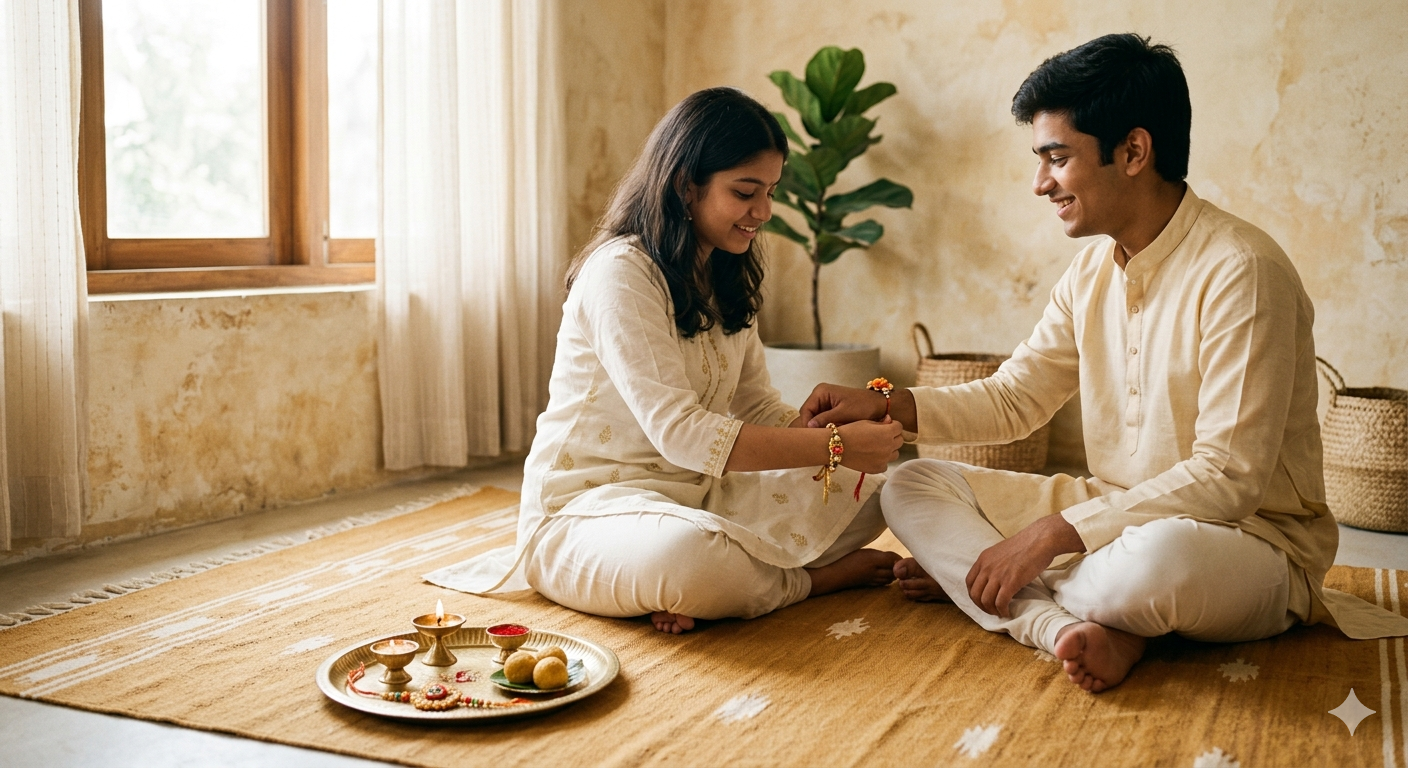
Raksha Bandhan — celebrated each year in the monsoon month of Shravan — is the annual renewal of the contract. The sister ties a Rakhi thread on her brother's wrist. He gives her a gift. He escorts her home. In rural North India, Raksha Bandhan was historically a primary reason for married women to travel back to their natal homes — it was the annual moment when the brother formally reaffirmed his responsibility.
Bhai Dooj — two days after Diwali — is the sister's ceremony. She prepares a ritual meal. She applies tilak. He brings gifts. The exchange here is the "debt balance" of the relationship — ensures the bond remains active and reciprocal through the year.
The Maayra — at the wedding of the sister's children — is the generation-spanning culmination. The brother's obligation extends not just to his sister but to her children. He is the maternal uncle — the Mama — and his presence at their wedding, and his gifts on that occasion, are the public declaration that the sister's children have a second family behind them.
The design is elegant. By spacing these obligations across the calendar year and across generations, the ancient system ensured that no life event — no festival, no wedding, no birth — passed without the brother materially acknowledging his sister's claim on the family's wealth.
The Brilliant Economics of the Liquid Share
The brother inherited land. Land cannot be divided infinitely without becoming worthless. Every generation that splits ancestral land among multiple sons fragments it further — but at least it stays intact if only sons inherit.
The sister's share, in this system, was never land. It was always liquid — gold, cash, cloth, jewellery, cattle. Things that could be transported to a new home. Things that could be converted to cash in an emergency. Things that did not require the fragmentation of the ancestral holding.
This was not accidental. It was a sophisticated economic design. The brother could maintain and build on an intact inherited estate. The sister received her share in a portable, useful, financially productive form. The ancestral wealth stayed intact and compounding. The daughter was financially supported without requiring the land to be broken up.
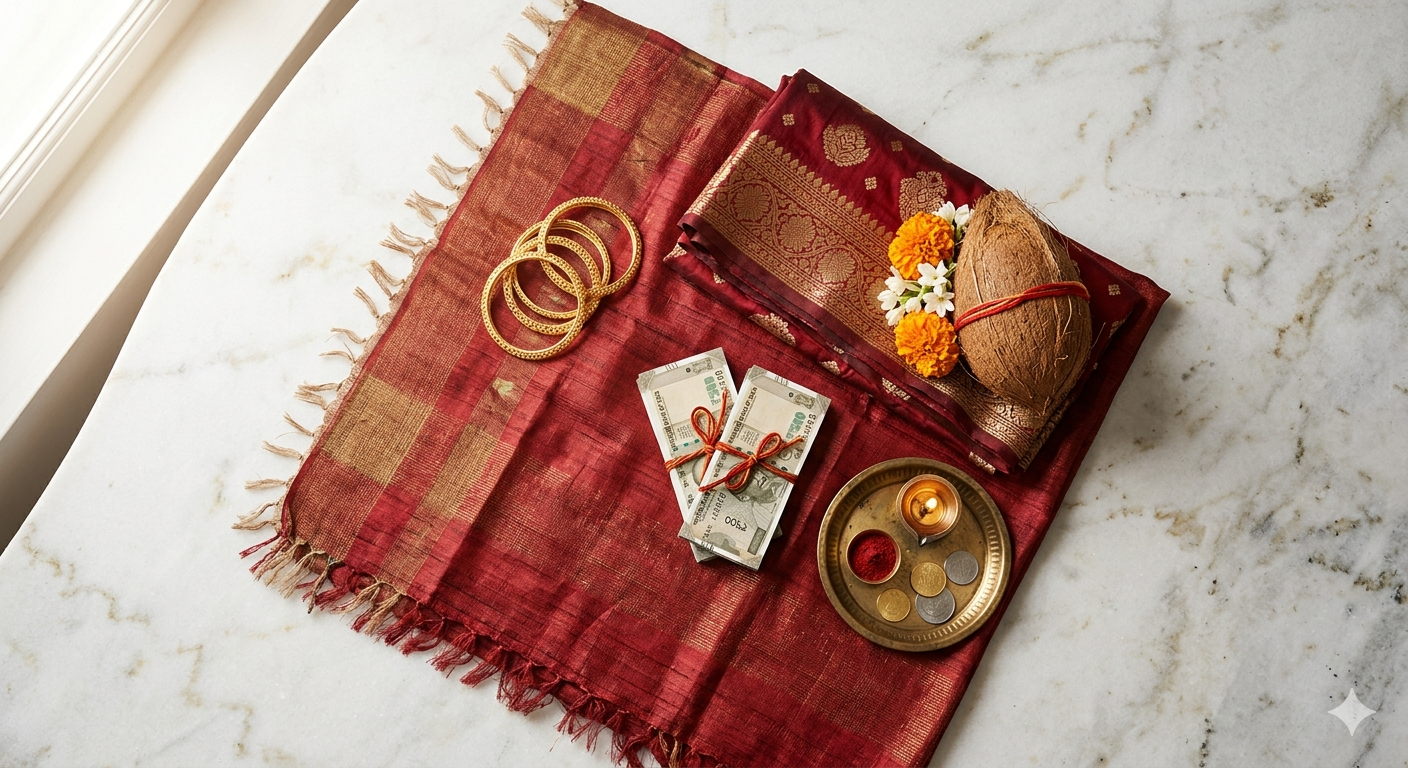
The gifts she received — under the concept of Streedhan — were legally hers alone. Indian courts, particularly the Supreme Court, have reiterated the sanctity of Streedhan and underscored that it is not a shared property but belongs solely to the woman — even her husband or in-laws have no legal claim over it. Section 14 of the Hindu Succession Act, 1956 states that any property possessed by a female Hindu, whether acquired before or after the commencement of the Act, shall be held by her as full owner and not as a limited owner — including movable and immovable property acquired by gift from any person, whether a relative or not, before, at or after her marriage.
In other words, the gold her Mama gave her at her wedding was legally hers — not her husband's, not her in-laws'. It was an independent financial reserve that she alone controlled. In a world where women had no property rights, these rituals was quietly creating them.
The Brother's Status Gain
This financial arrangement was not only good for the sister. It was designed so that the brother benefited too — in the currency that mattered most in traditional society: status.
The gifts at a Maayra are not given privately. They are given publicly, in front of both families, during the wedding. The scale of the Mama's gifts is a statement about the natal family's wealth and generosity. A generous Mama raises the bride's standing in her in-laws' home. He signals that she comes from a family of means and honour — people who will continue to support her. This protects her.
Simultaneously, the Mama who gives well is remembered. He earns the reputation of a man who honours his obligations — the highest social currency in community-based cultures. He is not depleting his wealth. He is converting it into status, social capital, and community standing that benefits his own family in return.
This is the system working as designed: both siblings gain. The sister gains financial security and social standing. The brother gains status and the satisfaction of public generosity. The family unit stays connected across the patrilocal divide that marriage creates.
The Safety Net Function
There is one more dimension of these rituals that is rarely discussed but was perhaps its most critical purpose.
In a patrilocal society — where a woman lives among her husband's family as a relative stranger — her vulnerability was real. Desertion, widowhood, financial distress, a bad marriage — any of these could leave her with nowhere to turn. Her husband's family had no obligation to her. Her father's family, technically, had transferred her out.
The continuous gifting cycle solved this by keeping the brother's door explicitly open. The annual Raksha Bandhan, the Bhai Dooj, the Maayra at the children's weddings — each occasion was a public renewal of the statement: she belongs to us. We are still her people. She can come home.
The Mama's presence at the wedding was not purely ceremonial. It was a message to the in-laws: this woman has a brother. She has people. She is not without recourse.
In communities where a woman's protection depended entirely on social relationships rather than legal ones, this message was not symbolic. It was structural protection.
What the Mythological Origin Reveals
Every ancient ritual that has survived centuries has a story attached to it. The story is never arbitrary — it encodes the values the ritual is meant to protect.
The mythological origin of the Maayra comes from the story of Naani Bai Ro Maayro — the devotee Narsinh Mehta's daughter, who was getting married but had no brother to perform the Maayra for her. In her desperation, her mother prayed to Lord Krishna. And Krishna — taking the form of the absent brother — performed the Maayra himself, providing gifts of extraordinary value so that the girl's wedding could proceed with honour intact.
The story is theologically significant. In the Hindu tradition, when God himself steps in to fill a role, it signals that the role is sacred and non-negotiable. The message is unambiguous: the absence of a brother at a sister's Maayra is a crisis serious enough to require divine intervention. No woman should face her wedding — or her marriage — without this economic and social anchor.
The ritual is so important, the mythology says, that even God could not allow a woman to go without it.
How Modern Culture Broke the System
These rituals were designed as a proportional, lifelong obligation — calibrated to what a brother could reasonably give, renewed regularly across a lifetime.
Modern culture has broken both of these design principles.
The extravagance problem. What was once a meaningful, calibrated transfer of wealth has become, in many communities, a competitive display. A viral video from a Rajasthan wedding in 2024 showed a bride's maternal uncle gifting ₹1.11 crore in cash — plus additional jewellery, property documents, and tractors — at a single Maayra ceremony. The video generated applause and controversy in equal measure. This is no longer a safety net. It is a performance.
The social pressure to give extravagantly at Maayra ceremonies has become a significant financial burden on the maternal uncle's family. Families take loans for Maayra. Brothers sell assets. The ritual that was designed to provide security has become a mechanism for demonstrating wealth — and, increasingly, for displaying wealth that does not actually exist.
The dowry corruption. Simultaneously, the in-laws' side has increasingly used the occasion of the wedding to make implicit — and sometimes explicit — demands for gifts directed at them. The wedding gifts were always intended for the bride. The groom's family was always a secondary recipient. When the groom's family begins to expect and demand specific gifts from the Mama, the ritual's protective function inverts entirely: the system designed to support the daughter becomes a mechanism for extracting wealth from her natal family under the cover of tradition.
This is the modern corruption of these rituals: the brother is financially depleted, the in-laws extract value, and the sister — the entire reason the ritual exists — is increasingly reduced to a bystander at a transaction that was created in her name.

The Haq Tyag Paradox
The research reveals one more layer of complexity that deserves acknowledgment.
Even after the Hindu Succession Act of 1956 granted daughters equal inheritance rights to ancestral property, a practice called Haq Tyag — voluntary renunciation of land rights — persists widely across North India. Daughters, often under social pressure from their brothers and broader family, sign away their legal right to ancestral land in exchange for the brother's continued gifting at Maayra and other rituals.
In other words: the law gave women the right. The social system offered them the old arrangement in exchange for surrendering it. And many women — valuing the ongoing relationship with their natal family over a legal claim that would create conflict — accept.
The Continious gifting system and the Haq Tyag together reveal the extraordinary durability of ancient social contracts. Even when the law changes, the ritual adapts to preserve the underlying arrangement. The brother's lifelong gifting continues to function as the "interest" on the ancestral wealth the sister renounced — exactly as it always did.
This is neither a simple good nor a simple harm. It is a testament to how deeply embedded the system is — and how much work remains to be done before legal rights translate into lived equality.
What Was Ancient, and What We Should Keep
The financial obligation of the brother towards her sister, stripped of its modern distortions, was a genuinely sophisticated piece of social engineering.
It addressed a real problem — the economic vulnerability of women in a patrilineal inheritance system — with a proportional, communal, ritualised solution. It made the brother's obligation public and recurring. It gave women portable, legally protected wealth. It kept natal family bonds alive across the patrilocal divide. It built a social safety net from the material available: family obligation, community honour, and ritual repetition.
The ancient designers of this system understood something that modern individual-rights frameworks often miss: that legal rights mean little without social enforcement mechanisms. A woman's right to her brother's support was not written in any ancient law. It was written in ceremony, in annual ritual, in the collective memory of an entire community that watched and remembered who gave what and when.
The modern corruption — the extravagance, the status competition, the dowry extraction — is not the right form of what was told by our ancestors. It is what happens when the purpose of a ritual is forgotten and only the performance remains.
The purpose was simple, and it was noble: make sure the girl of the house is never left without people.
