
In today’s world where we are surrounded by constant flux of information and distraction, a person who can just put his focus without getting distracted is a winner.
Meditation is one such technique through which one can achieve it.
Often the origins of meditiation fascinated me and hence I did some research on how this came into our knowledge base.
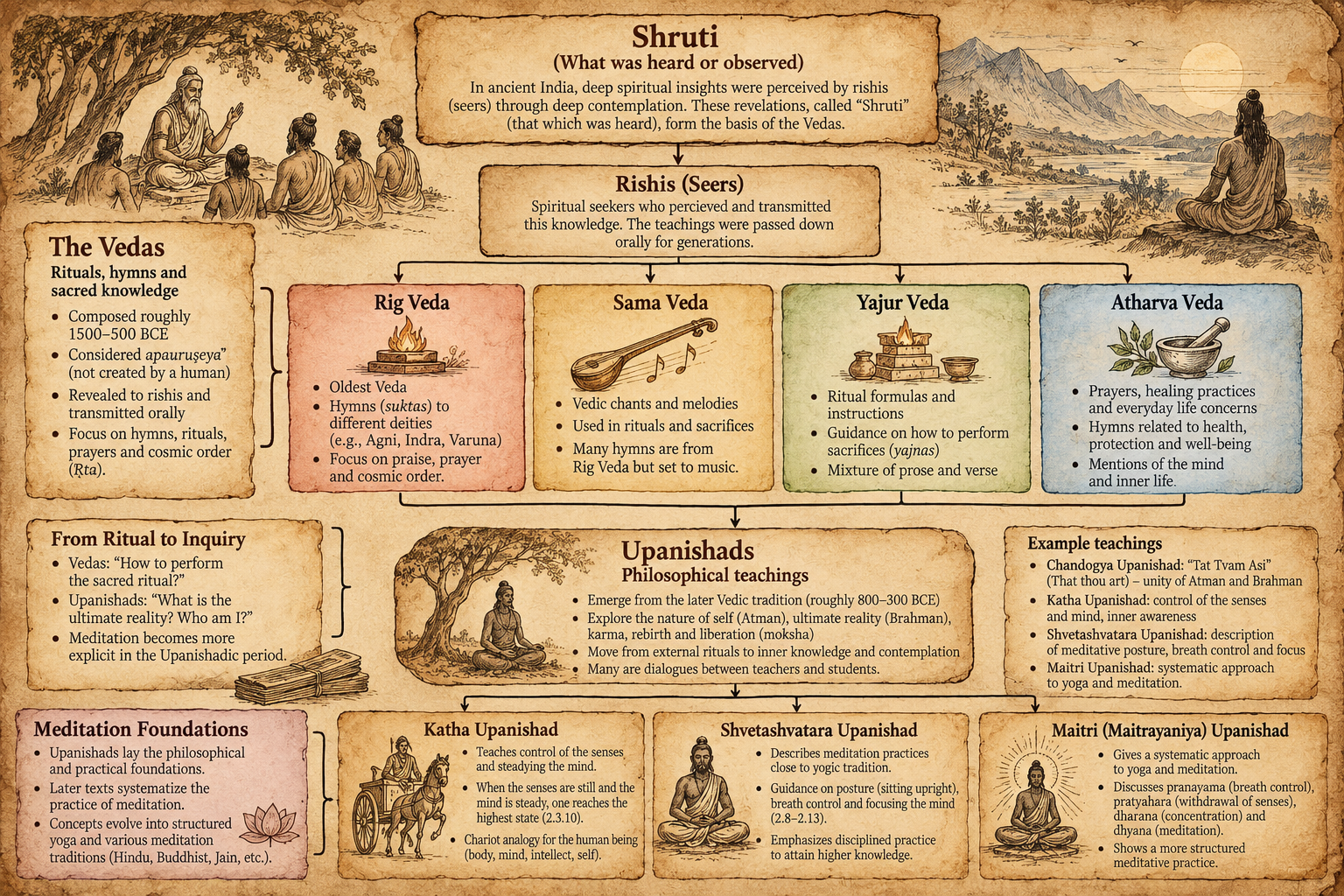
How meditation came into our lives
The Origins
The journey started with Shrutis, which was predominantly what people that time heard or observed. This knowledge was verbal in general and was passed onto generations. Finally, the Rishis made the four Vedas which were the religious practices and hymns they used to narrate. These were the hymns or chants to conduct a ritual.
After this came the upanishads which was the self discovery of a human being and inner learnings.
As a part of these Upanishads, the foundations of the meditations were laid out so that people can get practical ways to solve the problem.
How meditation benefits us?
Like any muscle which trains to become perfect, our human mind also follows the same pattern-
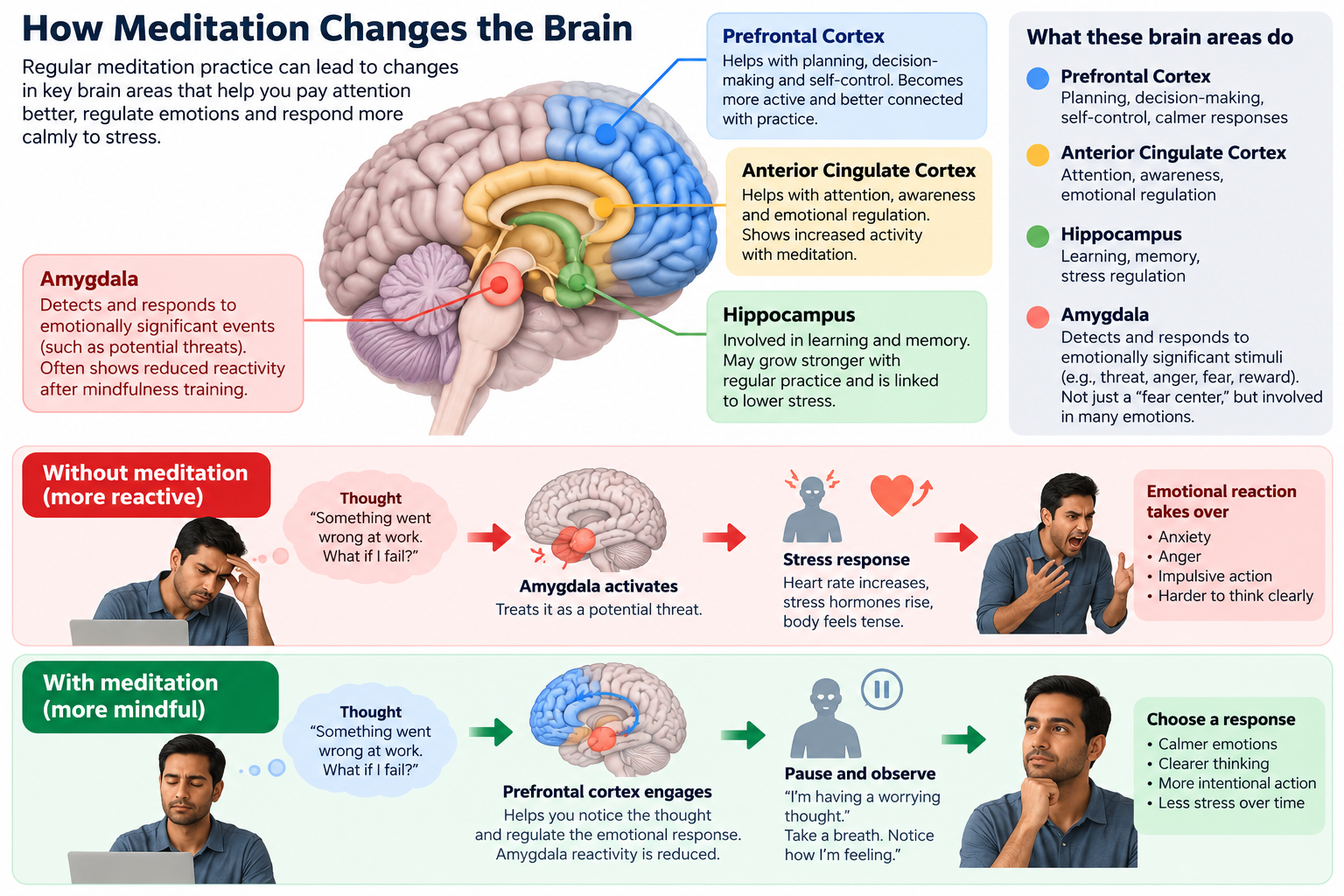
Meditiation trains our attention and changes how we respond to thoughts and emotions.
If we treat our mind like a muscle:
Normally, a thought appears → we automatically follow it.
With meditation, we practice noticing the thought without automatically following it.
Repeating this trains attention and emotional regulation.
It does this in part by calming the sympathetic nervous system (“fight-or-flight”) and activating the parasympathetic system. Studies show reductions in cortisol and self-reported stress scores.
Better focus and attention: Meditation strengthens attentional control. People who practice regularly often show improved performance on tasks requiring sustained attention and reduced mind-wandering.
How did world come to know about meditation?

Learnings passed to generations
Ancient Indian traditions developed practices over generations. A teacher would practice something, observe changes in attention, emotions, breathing, and awareness, teach it to students, and the students would practice and compare their experiences.
What is the science behind meditation?
Sources
Gotink RA, Meijboom R, Vernooij MW, Smits M, Hunink MG. 8-week Mindfulness Based Stress Reduction induces brain changes similar to traditional long-term meditation practice - A systematic review. Brain Cogn. 2016 Oct;108:32-41. doi: 10.1016/j.bandc.2016.07.001. Epub 2016 Jul 16. PMID: 27429096.
