
The Sacred Hearth: Why Ancient Traditions Forbid Continuous Eating
"Your digestive system is not a machine. It is a fire. And every time you snack, you are throwing wet wood on it."
It is vital to give your digestive system rest. In today’s world, where a plethora of food options are available for our taste buds, our digestive system has not evolved to consume at such a rapid rate. In the name of taste or intermittent hunger pangs, we often consume snacks, drinks, or take coffee breaks, thereby failing to give our digestive system the required downtime.
The Biological Case for Digestive Rest: Understanding the Gut’s "Internal Janitor"
It is logical to think that because your heart beats and your lungs breathe round the clock, your stomach should be built to digest 24/7. However, this is a misconception. Treating the digestive system like a simple conveyor belt ignores its complexity. It requires downtime for maintenance, repair, and cleaning.
The Migrating Motor Complex (MMC): How Your Body Cleans Itself
When your stomach and small intestine are empty for a few hours, your body activates the Migrating Motor Complex (MMC). Think of the MMC as the gut's internal janitor. It creates strong electrical and muscular waves that sweep undigested food particles, waste, and bacteria out of the upper GI tract and down into the large intestine.
Autophagy and Cellular Repair: Why Digestion Stops Detoxification
Digesting food is one of the most energy-intensive processes in the human body. When you eat, blood flow is heavily diverted to your gut to break down proteins, fats, and carbohydrates. If your body is constantly tied up in the demanding work of digestion, it cannot effectively allocate energy to other vital processes, such as autophagy (cellular repair), immune system maintenance, and brain detoxification. These processes primarily happen at night when the digestive system is supposed to be resting.
Chrononutrition: How Circadian Rhythms Govern Your Metabolism
Your organs do not function at the same capacity at 2:00 PM as they do at 2:00 AM. They are governed by circadian rhythms.
Insulin Sensitivity and the Dangers of Late-Night Eating
Your pancreas produces insulin to move glucose (sugar) from your food into your cells for energy. Your body is highly sensitive to insulin during the day, but in the evening, as your body prepares for sleep, insulin sensitivity naturally plummets. If you eat a meal late at night, your "sleeping" pancreas struggles to process it. The sugar stays in your bloodstream much longer, which damages blood vessels and drives fat storage.
Regeneration and the "Gym" Analogy
Just because an organ can perform a function doesn't mean it should do it constantly. If you go to the gym and lift weights 24/7 without a rest day, your muscles will tear and fail. The digestive organs—the stomach lining, the liver, the pancreas, and the gallbladder—need a daily fasting window to regenerate tissues and replenish digestive enzymes. Forcing them to work on impulse eventually leads to burnout, manifesting as acid reflux, insulin resistance, and a sluggish metabolism.
Eating at the wrong time doesn't just affect digestion — it directly disrupts your sleep. Here is what ancient cultures knew about sleep that modern science now confirms."
Ayurveda and the Digestive Fire: Protecting Your Agni
In Ayurveda, digestion is considered the cornerstone of all health.
Agni (The Digestive Fire) and Ama (The Toxic Sludge)
Ayurveda views your digestive system as a literal fire (Agni). For a fire to burn cleanly, you must add logs at the right time. If you constantly throw twigs on it all day, it either smolders or burns out.
Vishamashana (Irregular Eating): This refers to eating at random times or before the previous meal is digested.
Ama: When you practice irregular eating, your Agni gets weak. Food turns into a sticky, toxic metabolic byproduct called Ama. Ayurveda teaches that Ama settles in weak areas of the body, becoming the root cause of chronic inflammation and disease.
Traditional Chinese Medicine (TCM): Strengthening Spleen Qi and Flow
In TCM, the Spleen (Pi) and Stomach (Wei) are compared to a mill or a cooking pot. For the "fire" to stay lit and the "mill" to grind efficiently, it needs space and occasional stillness to cultivate Post-Natal Qi.
The "Fu" Organ Philosophy: Why Your Digestive Pipes Must Be Emptied
The Stomach and Intestines are Fu (hollow) organs. Their nature is to be "filled and then emptied." If you eat continuously, the "pipes" are never empty, leading to Food Stagnation (Ji Shi), where undigested food sits and rots, creating internal heat and "Dampness."
The 70% Rule: Providing Mechanical Space for the Stomach
TCM advocates for the "70-80% Full" rule. Imagine a blender: if you fill it to the very top, the motor struggles. Leaving 30% of the stomach empty provides the mechanical space necessary for the Stomach to churn and the Spleen to transform nutrients.
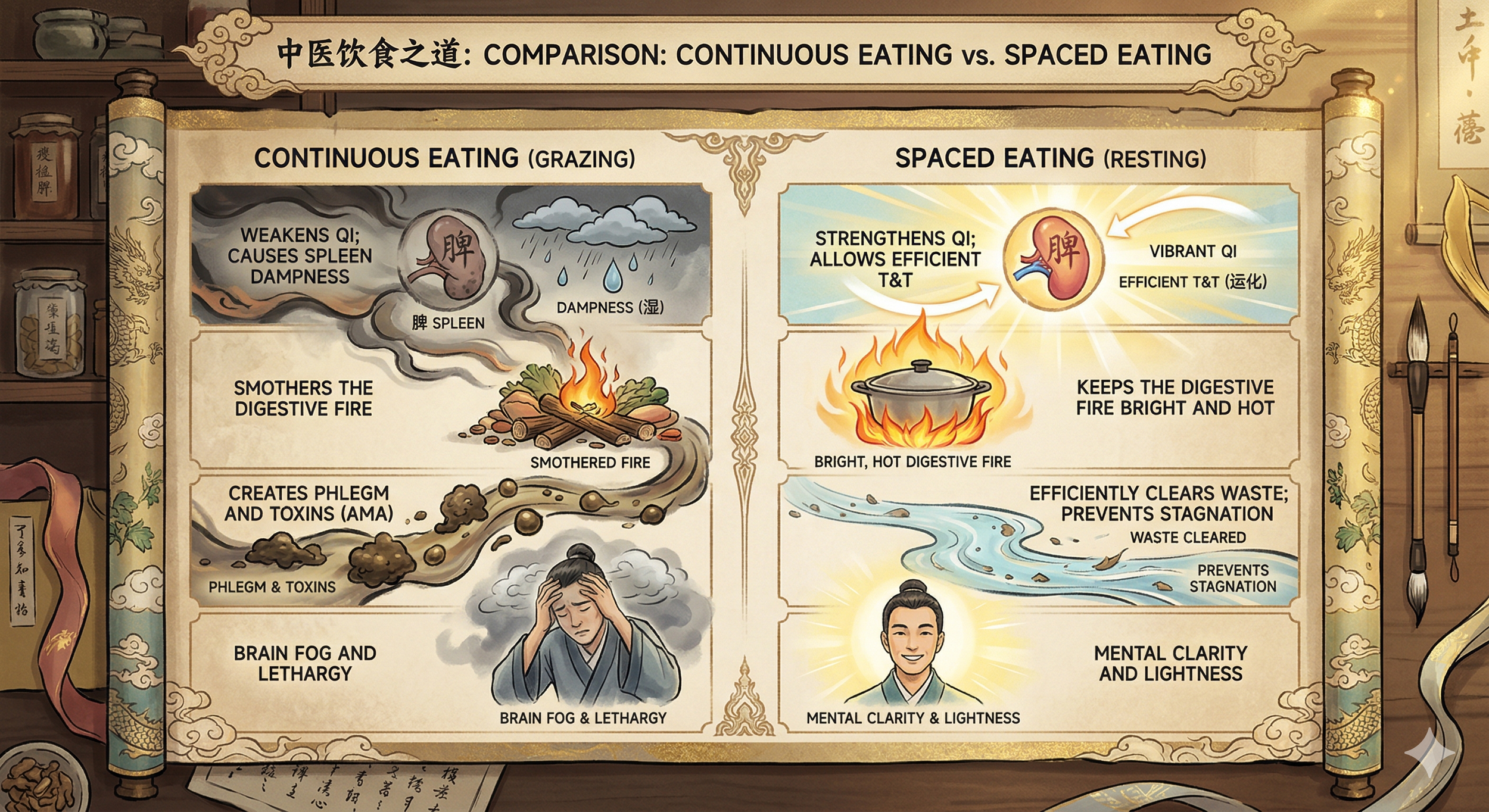
How to Restore Your Natural Rhythm: Practical Tips for Digestive Health
Modern science has discovered the exact same mechanism as the ancients through the study of chrononutrition. Every organ has its own clock. By the evening, your digestive system is essentially trying to "clock out" to focus on repair.
Ending the Grazing Habit: Spaced Eating for Better Metabolism
Historically, humans ate when the sun was up, and food took effort to prepare. To counter the modern trap of impulse eating, bring predictability back to your body:
Eat at Consistent Times: Try to have your main meals within the same 1-hour window every day.
Stop the Grazing: Give your body 3 to 4 hours between meals to allow the MMC "janitor" to work.
The "Empty" Night: Stop eating at least 2 to 3 hours before sleep to focus on Blood and Yin renewal.
Prioritize Warmth: TCM teaches that the digestive system hates "Cold." Choose cooked, warm foods to assist the Spleen’s "cooking" process.
Conclusion
Despite developing thousands of miles apart, TCM and Ayurveda arrived at almost identical conclusions: the gut is the center of health. It is incredible how these ancient ways of thinking are now being validated by modern science regarding the Migrating Motor Complex and Autophagy. Health is not just about what you put in, but about giving your body the space to process what is already there.
Sources:
Deloose E, Janssen P, Depoortere I, Tack J. The migrating motor complex: control mechanisms and its role in health and disease. Nature Reviews Gastroenterology & Hepatology. 2012;9(5):271–285. 🔗 https://pubmed.ncbi.nlm.nih.gov/22450306/
Levine B, Kroemer G. Autophagy in the Pathogenesis of Disease. Cell. 2008 Jan 11;132(1):27–42. 🔗 https://pubmed.ncbi.nlm.nih.gov/18191218/
Charaka Samhita, Sutra Sthana 25/40 — on Vishamashana and Agni 🔗 https://www.carakasamhitaonline.com/index.php/Agni
