
Why Ancient Cultures Never Had a Bedtime Routine — And What We Lost?
The modern bedtime routine — bath, story, white noise, cry-it-out — is one of the most stressful rituals in parenting. Ancient cultures didn't have one. Their children slept anyway.
Every night, millions of parents wage the same exhausting battle. The swaddling. The rocking. The white noise machine. The frantic Googling at 2am. And underneath all of it — a nagging guilt that somehow, they are doing it wrong.
What if the routine itself is the problem?
For more than 99% of human history, no parent on earth put their baby in a separate room to sleep alone. Not in India. Not in Japan. Not in ancient Greece or Maya or the forests of sub-Saharan Africa. The idea that an infant should sleep independently — in a crib, in a nursery, in a different room — is not a medical discovery. It is barely 200 years old. And it was not born from science. It was born from the Industrial Revolution.
What A Human Baby Actually Is?
To understand why ancient cultures slept the way they did, you first need to understand what a human infant actually is at birth.
Unlike most mammals — foals that walk within hours, elephants that navigate their environment within days — a human newborn arrives in a state of profound incompleteness. Human infants are born with only 25% of their adult brain volume. Their heart rate, breathing patterns, and body temperature cannot yet regulate themselves. Their immune systems are still developing. Their respiratory control is immature.
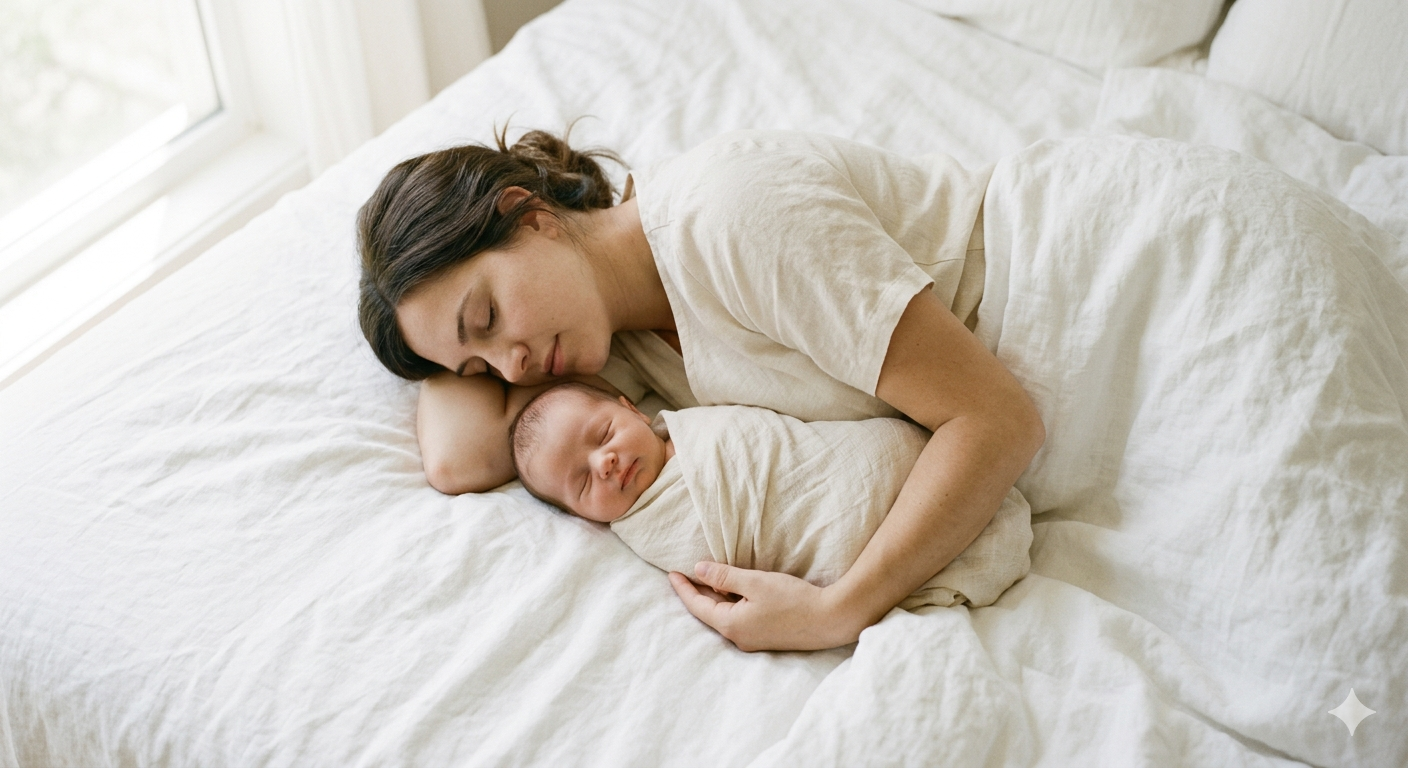
Professor James McKenna of the University of Notre Dame — the world's leading authority on mother-infant sleep — calls the human infant an exterogestate: a being that completes its gestation outside the womb, on the body of its mother. In this framework, the mother's body is not a comfort object. It is a biological necessity. Her breathing regulates the infant's breathing. Her warmth regulates the infant's temperature. Her heartbeat — familiar since the womb — regulates the infant's heart.
Research from McKenna's Mother-Baby Behavioral Sleep Laboratory at Notre Dame documented this in physiological detail: when mothers and infants sleep in proximity, they synchronise their breathing cycles. The mother's exhaled carbon dioxide acts as a gentle stimulant for the infant's inhalation. Separation removes this regulator entirely.
When Solitary Sleep Was Invented
Family bedsharing was the global standard until roughly 200 years ago — even in Britain and the United States. The shift was not driven by a medical breakthrough. It was driven by the factory.
As the Industrial Revolution took hold in the 18th and 19th centuries, working-class mothers needed consolidated, uninterrupted sleep to sustain factory labour. Infants who woke frequently became a practical problem. The solution was not more support for mothers — it was the separation of the infant.
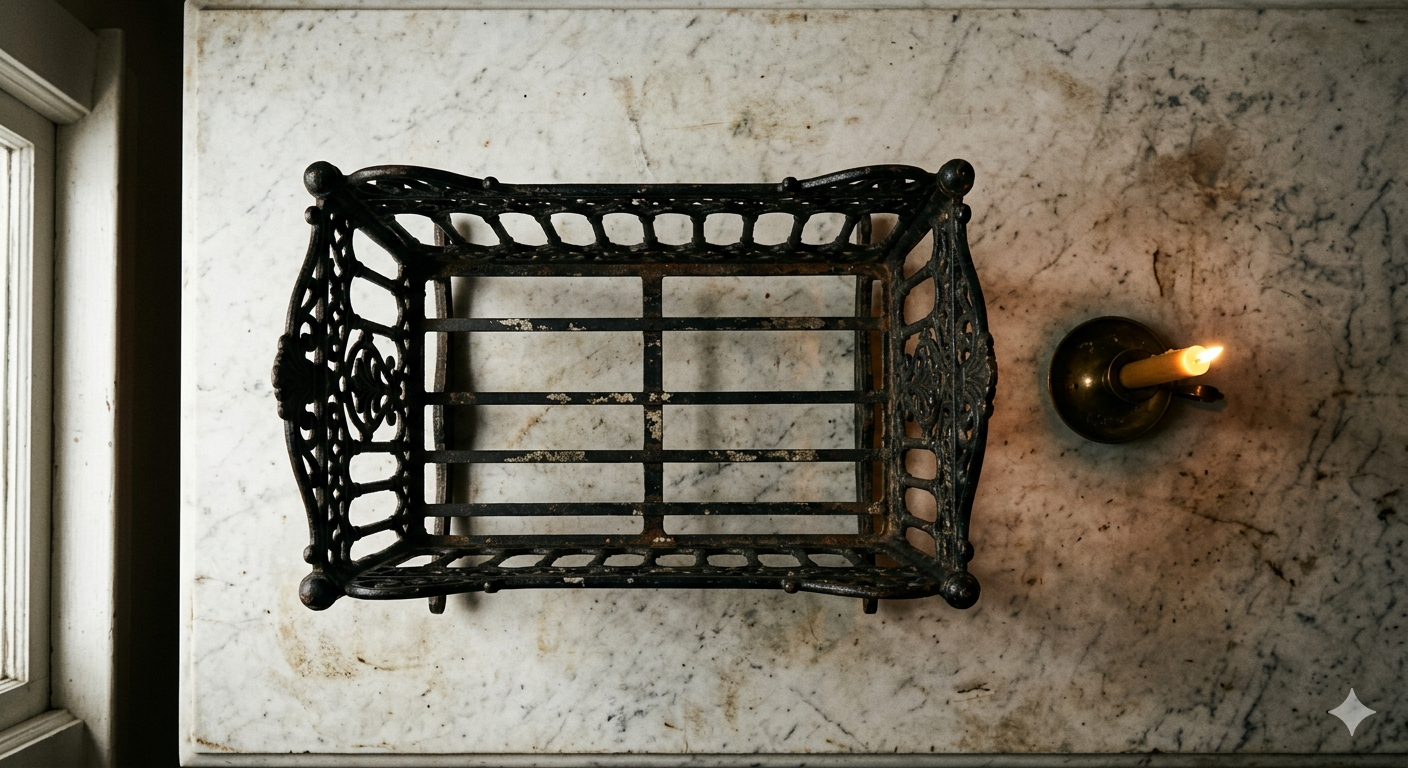
Simultaneously, the growing middle class began to see a dedicated nursery as a status symbol. Larger houses meant separate rooms were possible. The cradle — portable, kept near the mother — was replaced by the stationary iron crib, positioned in a dedicated room. Victorian doctors warned that adult breath was "loaded with impurities" dangerous to infants. The nursery became a symbol of good parenting.
Then came the experts.
Dr. Luther Emmett Holt, author of the 1894 bestseller The Care and Feeding of Children, pioneered what we now call cry-it-out. His justification? Crying developed the lungs. His prescription:
"A distressed infant should simply be allowed to 'cry it out.' This often requires an hour, and, in some cases, two or three hours."
There was no scientific basis for this claim. None.
Then came John B. Watson, the behaviorist whose 1928 manual warned parents against "the dangers of too much mother love":
"Never hug and kiss them, never let them sit in your lap. If you must, kiss them once on the forehead when they say good night. Shake hands with them in the morning."
These views — rooted in ideology, not biology — were adopted by government pamphlets and medical authorities across the Western world. A generation of parents was taught that their instinct to hold their crying child was weakness. That responsiveness would create dependency. That distance built character.
Modern developmental science has thoroughly dismantled these claims. But their legacy persists in every white noise machine sold.
What The World Actually Did
Outside this narrow 200-year Western experiment, the picture is remarkably consistent.
In the survey of 186 non-industrial societies published in anthropological literature, children sleep in the same bed as parents in 46% of cultures and in the same room in an additional 21%. In other words — in 67% of the world's cultures, children sleep in the company of others. In none of those 186 cultures do babies sleep in a separate space before they are at least one year old.
In Japan, co-sleeping — called soine — is the cultural norm and is often practised until the child reaches puberty. Japanese families sleep in the shape of the kanji character for river (kawa no ji): child in the middle, parents on either side like riverbanks. The practice cultivates what the Japanese call anshinkan — a deep sense of contentment, security, and relief from physical closeness. Japanese culture views the Western push for early infant independence not as progress but as merciless.
In Highland Mayan communities, solitary infant sleep is so unusual it is considered unkind. All children sleep with their mothers until toddlerhood. There are no bedtime routines, no transition objects, no sleep training. When researchers explained the American approach to Mayan mothers, they expressed pity for American infants who had to sleep alone.
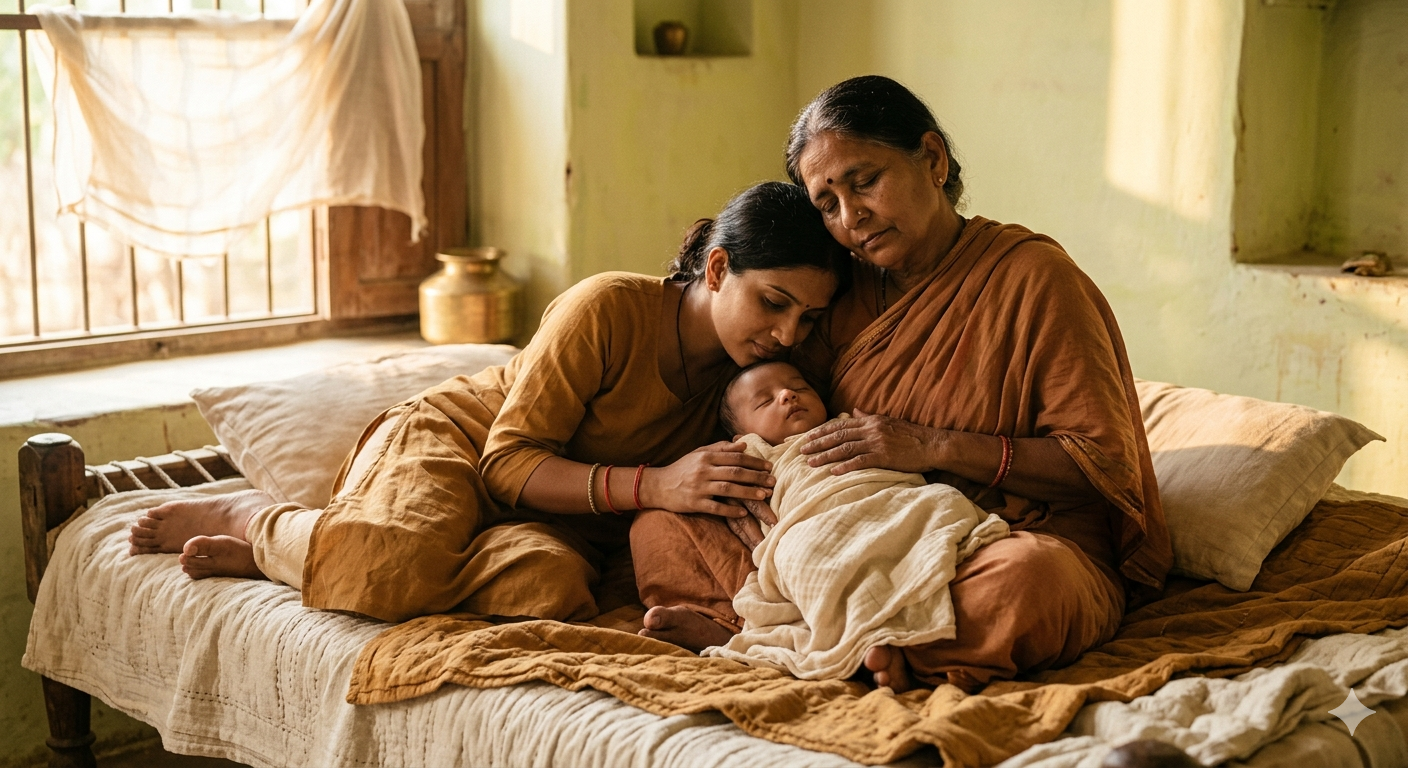
In India, soine has its ancient equivalent in the joint family sleep tradition — infants sleep with their mothers, often in multi-generational sleeping arrangements that provide constant warmth, touch, and stimulus. The Kashyapa Samhita — the only Ayurvedic text wholly dedicated to child care — recognised Kaumarabhritya (the care of children) as one of the eight branches of Ayurveda, placing infant health at the very centre of medical practice.
Co-sleeping knowledge passed from one generation to other.
What The Ayurvedic Texts Say
The Kashyapa Samhita — attributed to the sage Kashyapa and recognised as the foundational Ayurvedic text on paediatrics — offers a perspective that aligns precisely with modern evolutionary biology.
Ayurveda identifies three pillars of life — Trayo Upastambha — that are essential for sustaining health: Ahara (food), Nidra (sleep), and Brahmacharya (regulated conduct). The Charaka Samhita states directly: "Happiness, nourishment, strength, virility, knowledge, and life itself depend on proper sleep."
Crucially, in the Ayurvedic view, an infant's disturbed sleep is never treated as a behavioural problem to be trained away. It is a clinical signal — an indicator of Dosha imbalance requiring attention, warmth, and closeness. Vata disturbance causes restlessness and high-pitched crying. Pitta imbalance manifests as warmth and irritability. The prescribed response is always proximity, touch, and nourishment — never separation.
The Kashyapa Samhita's prescriptions for neonatal care — swaddling, massage, Lehana formulations of ghee and honey to build immunity — all assume the constant presence of the mother's body. There is no prescription for solitary sleep because the concept did not exist.
What Modern Science Confirms
McKenna and his colleague Lee Gettler coined the term breastsleeping to describe what they argue is the human species' fundamental sleep arrangement: a breastfeeding mother and infant sharing a surface in the absence of known hazards.
Their peer-reviewed commentary in Acta Paediatrica (2016) states directly: "There is no such thing as infant sleep, there is no such thing as breastfeeding — there is only breastsleeping."
The physiological evidence is accumulating:
Two peer-reviewed studies from the Netherlands — published in Psychoneuroendocrinology (2012) and the Journal of Stress (2013) — found that infants in solitary sleep arrangements in their first month showed significantly higher cortisol responses to mild stressors, and that more weeks of co-sleeping in the first year predicted lower cortisol reactivity at 12 months. In other words, the "independence" trained by solitary sleep may not be independence at all. It may be a state of chronic low-level stress.
A separate study published in Archives of Disease in Childhood found that children who had co-slept in the parental room had lower basal cortisol levels between the ages of 3 and 8 compared to those who had slept alone.
On the question of SIDS — Sudden Infant Death Syndrome — McKenna's research argues that the Western fixation on deep, consolidated infant sleep may itself be a risk factor. Co-sleeping infants spend more time in lighter REM sleep stages, waking more frequently to nurse. These frequent arousals are protective. An infant who cannot rouse itself from dangerously deep sleep during a respiratory event is more vulnerable, not less. The disrupted sleep Western parents are taught to eliminate may be a biological safeguard.
The Honest Note
This article does not prescribe how you should arrange your family's sleep. Every family is different. Safety matters — sofas, impaired caregivers, and smoking are genuine hazards regardless of sleep arrangement.
What this article does say is that the default Western model — infant alone, in a crib, in a separate room — is not a medical recommendation backed by evolutionary biology. It is a cultural preference, barely 200 years old, born of factory schedules and Victorian ideology, enforced by experts whose advice had no scientific foundation.
Ancient cultures — from India to Japan to the Maya — arranged infant sleep around one principle: the biological need of a developing human being for proximity, warmth, and regulation. Modern science is now confirming, with cortisol studies and anthropological surveys and physiological recordings, what every grandmother in every ancient culture already knew.
Your instinct to hold your child is not weakness. It is biology.
Sources
McKenna JJ, Gettler LT. There is no such thing as infant sleep, there is no such thing as breastfeeding, there is only breastsleeping. Acta Paediatrica. 2016;105:17–21. 🔗 https://onlinelibrary.wiley.com/doi/abs/10.1111/apa.13161
Tollenaar MS et al. Solitary sleeping in young infants is associated with heightened cortisol reactivity. Psychoneuroendocrinology. 2012;37(2):167–177. 🔗 https://pubmed.ncbi.nlm.nih.gov/21530088/
Beijers R et al. Cortisol regulation in 12-month-old infants: associations with co-sleeping and breastfeeding. 2013. 🔗 https://pubmed.ncbi.nlm.nih.gov/23116166/
Thoman EB. Co-sleeping, an ancient practice. Sleep Medicine Reviews. 2006;10(6):407–417. 🔗 https://pubmed.ncbi.nlm.nih.gov/17112752/
BASIS — Baby Sleep Information Source. Infant Sleep in History and Around the World. 🔗 https://www.basisonline.org.uk
Kashyapa Samhita — Kaumarabhritya. 🔗 https://en.wikipedia.org/wiki/Kashyapa_Samhita
Charaka Samhita, Sutrasthana 21 — on Nidra (sleep). 🔗 https://www.carakasamhitaonline.com
